Resources /
Blogs
Heat and more heat: The strategy Sinner followed to win Wimbledon
July 20, 2026
Nithin

Something strange is happening in elite tennis. While everyone else worries about rising heat, a few players are turning it into an advantage.
At the 2026 French Open in May, the heat drew more attention than the tennis. Players described heatstroke symptoms. And top seed Sinner experienced severe cramps and had to walk out of the tournament after being defeated for the first time in 31 matches.
Jannik Sinner's Wimbledon triumph can almost certainly be attributed to his recent training, which has him under the open sky more than ever. But before that, let’s familiarize ourselves with the new climate the sport exists in.
Ambee followed the cumulative heat at Roland Garros very closely. Cumulative heat is the environmental load an athlete builds up over time. It is the combined effect of repeated exposure to heat, UV radiation, poor air quality, and humidity, compounding from one match to the next rather than resetting each day.
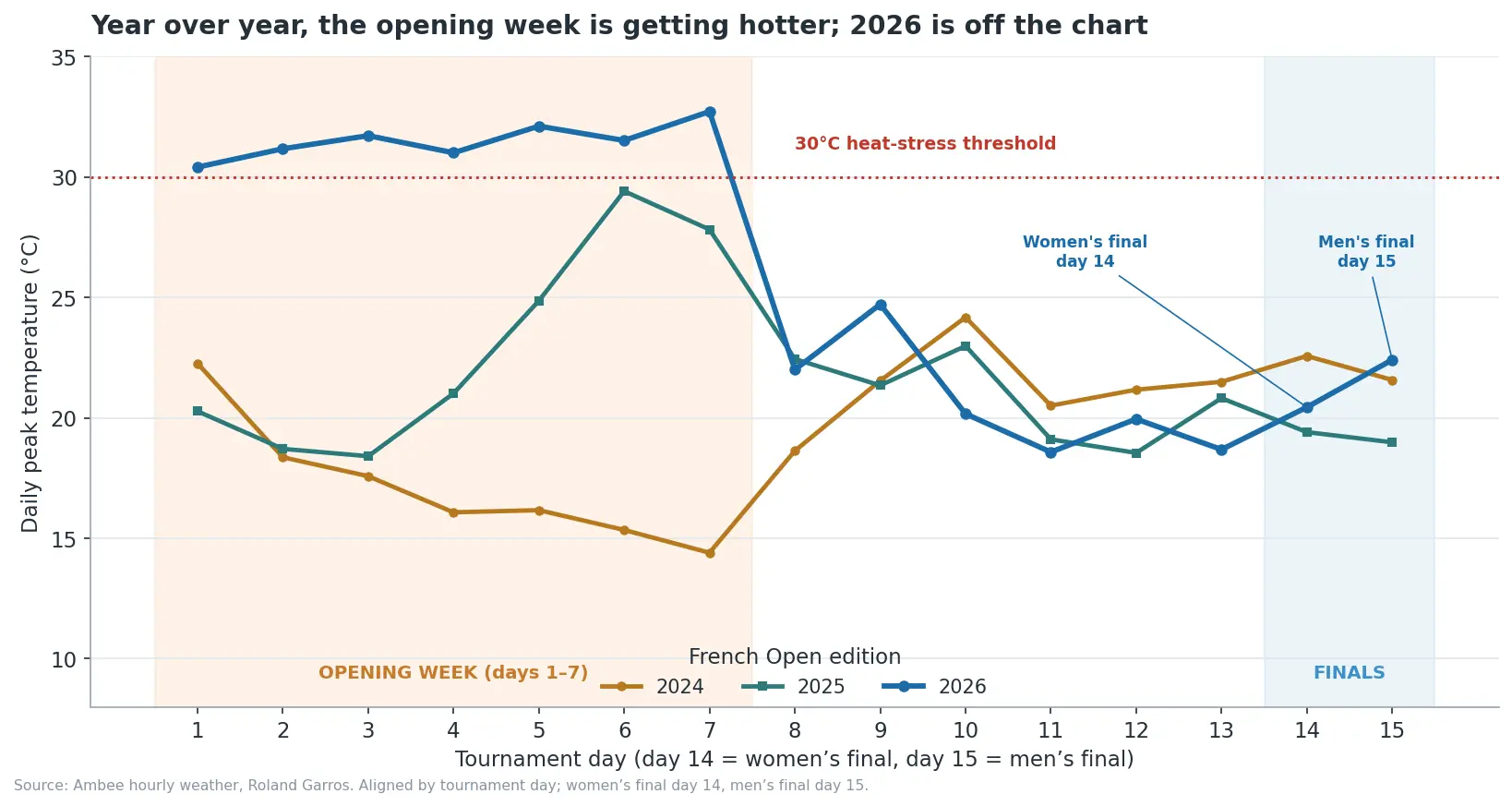
By that measure, 2026 stood apart from the two editions before it. For the opening week, the conditions at Roland Garros were severe. From 24 to 30 May, the temperature passed 30°C every day and peaked at 32.7°C. The UV index hit 7, the top of the "high" range, with 22 hours at high-UV levels.
After the first week, the conditions eased sharply. Daytime temperatures fell from around 30°C to near 20°C. The hours above 30°C dropped from 46 to zero. High-UV hours fell from 22 to 4.
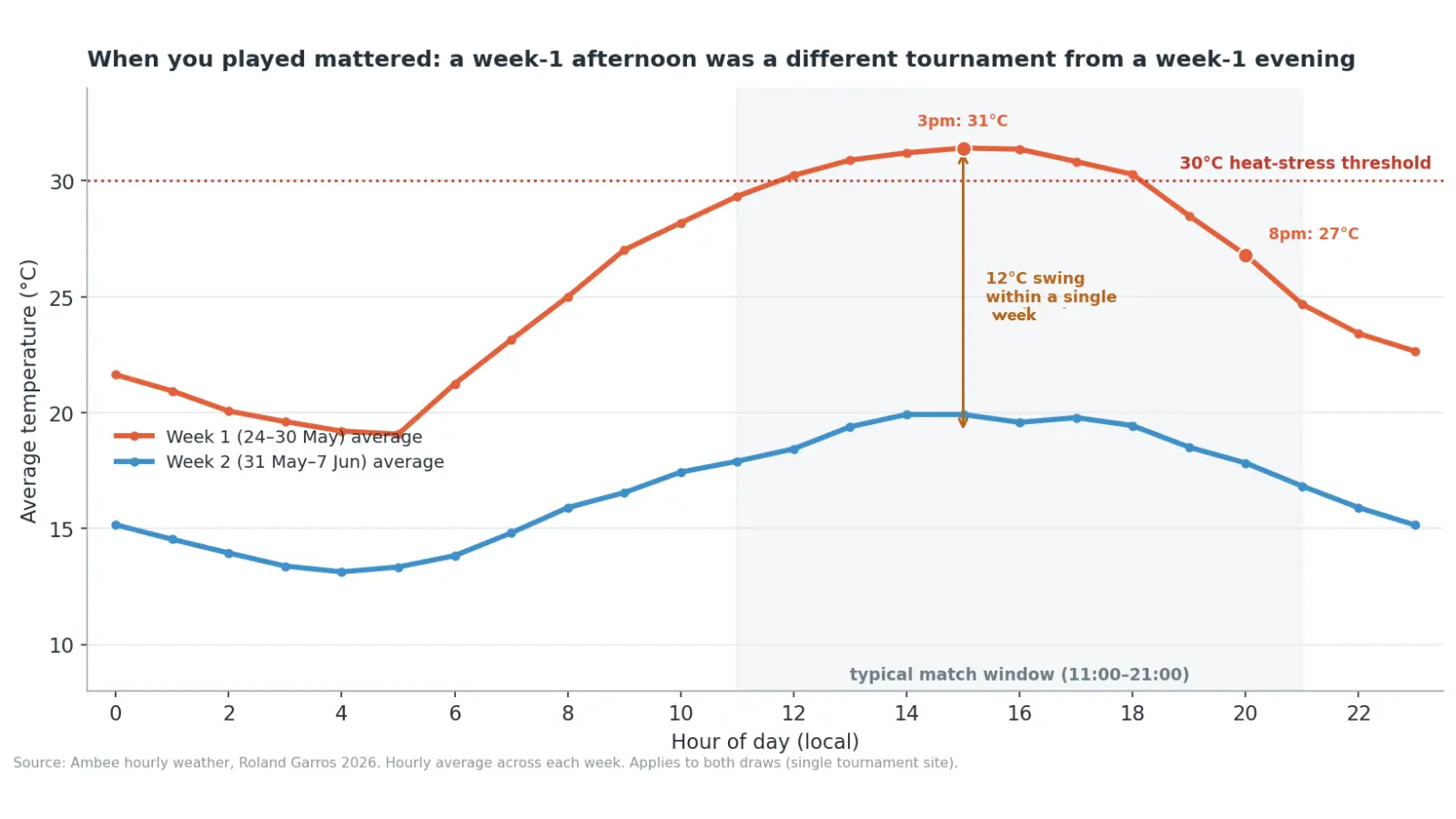
Sinner seems to have embraced a reality that many athletes are yet to come to terms with. In his own words: “I feel like everywhere we play is going to be very hot.” The French Open, the Australian Open, and Wimbledon all point in that direction.
Keeping that in mind, Darren Cahill has introduced several small changes to Sinner's preparation, one of which was clearly visible throughout Wimbledon, where he regularly left the court between sets to cool off in the air conditioning and change into a fresh shirt, even when it wasn't strictly necessary.
"It's about getting in a routine on the warmer days to make sure that he’s doing everything possible to play at his top level on those super hot days.”
Cahill also highlighted something very interesting that could reshape how players prepare for competition
After her Wimbledon quarterfinal, four-time Grand Slam champion Naomi Osaka was asked whether the rising heat was widening the already razor-thin margin between winning and losing. She said yes, but not in the direction most people would expect. Osaka claimed that if the conditions had been even hotter, she likely would have won because extreme heat seems to elevate her performance, almost as if it activates her abilities on court.
But why would she say something so unusual?
Osaka spent part of her formative years training at the Harold Solomon Tennis Institute in Fort Lauderdale, Florida, where heat and humidity are simply part of everyday practice.
Jannik Sinner's coach, Darren Cahill, offered the opposite perspective:
"He's a redhead that lives in the north of Italy, that grew up in the snow and the Alps. Hot weather is a little bit different for him than it is for most people. The more time he spends in the heat, the better he's going to be at it."
That reveals something easy to miss.
With heat waves becoming more common, it's tempting to conclude that everyone should simply train in hotter environments. But Osaka’s narrative proves that it isn't so simple.
Earlier this year, we shared five years of historical climate data, including temperature, humidity, air quality, precipitation, and pollen levels, with Dr. Naomi Datson, Senior Lecturer in Applied Sport and Performance at Manchester Metropolitan University.
Dr. Datson works with an elite football club in London, preparing players for international tournaments. We mapped environmental conditions to every venue and match date, allowing the performance team to compare overseas conditions with those the players train in at home, months before they travel.
That gave coaches time to adjust training loads, plan recovery around periods of higher environmental stress, and optimize travel and acclimatization schedules before the tournament even began.
[Read more about Dr. Datson’s research here.]
Now imagine applying the same approach to Wimbledon.
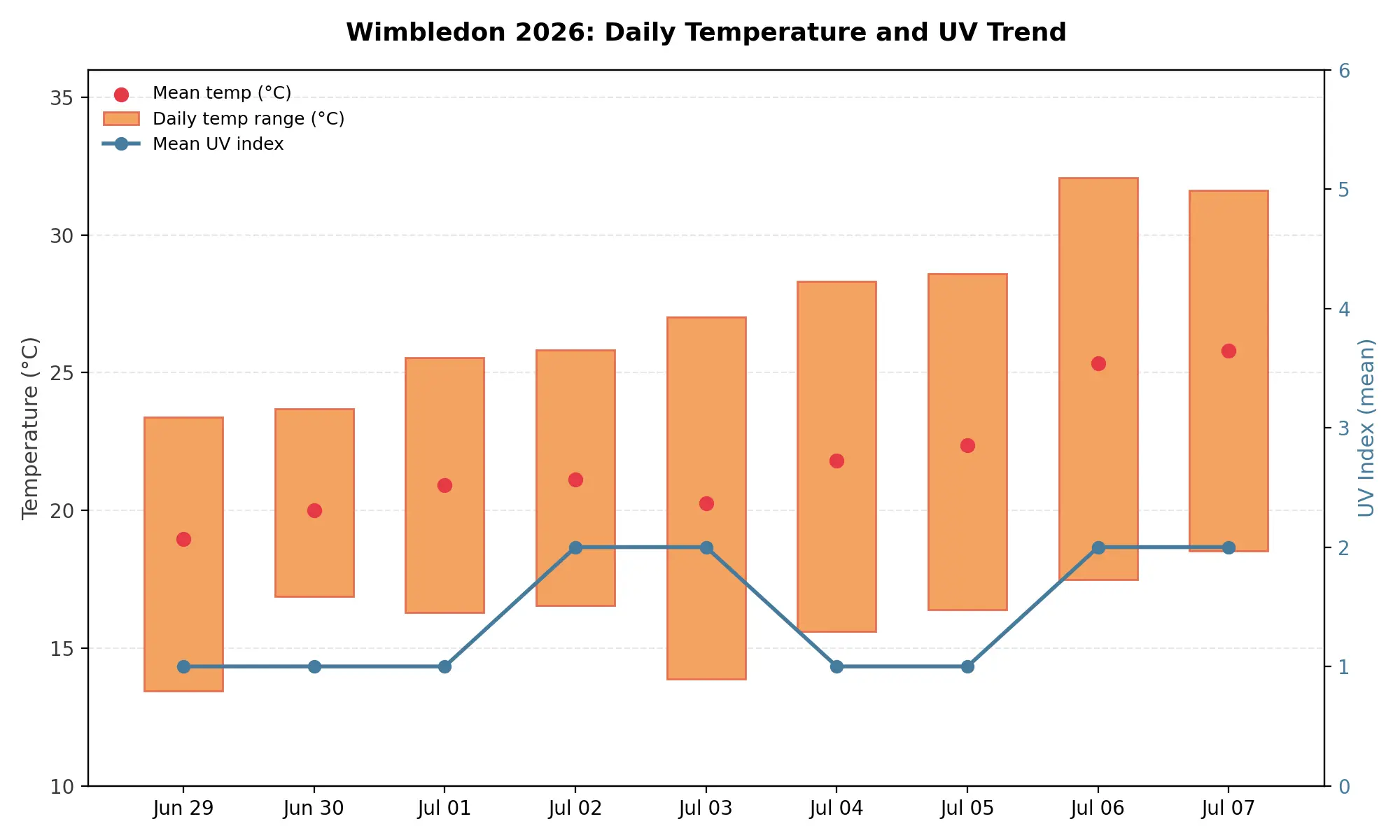
Across the tournament, temperatures climbed nearly 9°C from open to peak. Knowing what we know about Osaka's and Sinner's physiological strengths, those changing conditions become a roadmap for training rather than a surprise on match day.
Sinner and Osaka are among the world's most accomplished tennis players. Sinner won Wimbledon because of exceptional talent, relentless preparation, and a team willing to refine even the smallest details.
What we've outlined here is only a glimpse of what's possible for athletes and performance teams
Imagine knowing the expected temperature, humidity, UV index, wind, pollen, and air quality for every court you'll compete on, days, weeks, or even months in advance.
Every training session becomes more intentional. Every recovery plan, travel schedule, and acclimatization decision is backed by data.
Players practically get to rehearse tomorrow's match before tomorrow ever happens.
With high-resolution observations and forecasts, Ambee's climate intelligence unlocks another training determinant alongside nutrition and biomechanics.
🔗 Want to see what climate intelligence looks like for your competition schedule? Get in touch to explore custom climate intelligence for your venues, timelines, and performance objectives.
00:00
/
00:00
00:00
/
00:00
00:00
/
00:00
00:00
/
00:00