Influenza-like Illness risk, before the season arrives
30-day risk forecasts for influenza-like illness, covering cold, cough, and related respiratory illness.
30-day risk forecasts for influenza-like illness, covering cold, cough, and related respiratory illness.







CDC. (2024). Glossary of influenza (flu) terms.
CDC. (2025). U.S. influenza surveillance: Purpose and methods.

Risk levels for tracking cold, cough, and related respiratory illness trends 30 days ahead.

Currently covers the United States and Germany, with more countries on the way.

Minimal, Low, Moderate, High, and Very High, calibrated to the CDC's influenza surveillance scale.

Built on official health surveillance and deep seasonal environmental histories.

Ambee forecasts ILI risk ahead of conventional surveillance, which reports activity only after cases are recorded.

The forecast refreshes daily, incorporating the latest health surveillance inputs and environmental conditions.
Ambee's risk levels follow the same logic the U.S. CDC uses for influenza surveillance. For each location, we build a baseline from the past three seasons, then measure how far each forecast sits above it, keeping risk comparable across regions. Scores map onto a 13-step activity scale, grouped into five categories from Minimal to Very High.
Forecasting illness means watching more than case counts. Ambee pairs official health surveillance data with seasonal histories and pollen and weather conditions, refreshed to project ILI risk accurately.
ILI incidence data is ingested from official national health surveillance systems (e.g., CDC in the United States) alongside weather and pollen data.
Health surveillance inputs are combined with present and forecast pollen and weather signals alongside deep histories to understand variations in each season and region.
The forecast is rerun every day as new surveillance data and environmental conditions become available, ensuring the risk reflects actual, on-ground conditions.
All forecasts are benchmarked against national surveillance reports to ensure accuracy.
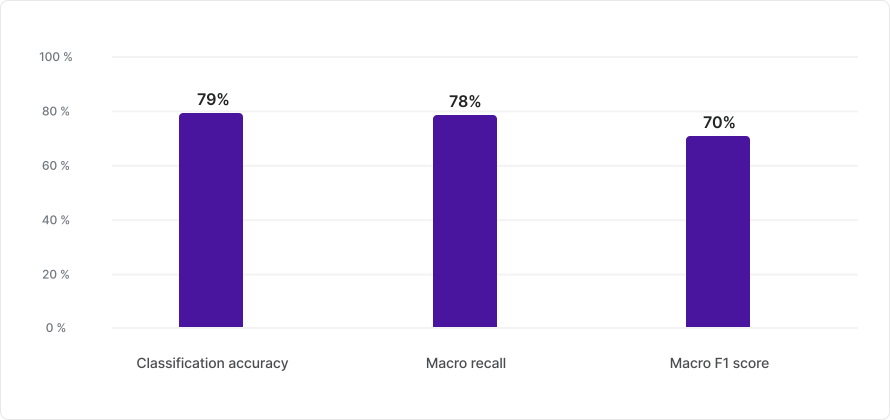
Ambee's ILI data is benchmarked against actual CDC-reported risk labels for US counties. The January 2026 validation results are as follows:
A longer forecast horizon, richer environmental inputs, and daily updates.
Typical providers
Categorical ILI risk forecast
ILI incidence only
30 days
Up to 7 days
Daily
Weekly
Daily
Weekly
Country/State/County level
State or regional level
The USA and Germany. More countries available soon
Primarily the US
Stage OTC inventory ahead of seasonal peaks, with 30 days of lead time to act without overcommitting in the wrong geographies.

Pre-position antiviral and symptom-relief SKUs by state and county before demand hits.

Trigger HCP outreach, consumer media, and promotional timing on rising ILI risk.

Surface location-relevant guidance, product prompts, and appointment nudges as ILI risk climbs in a user's area.

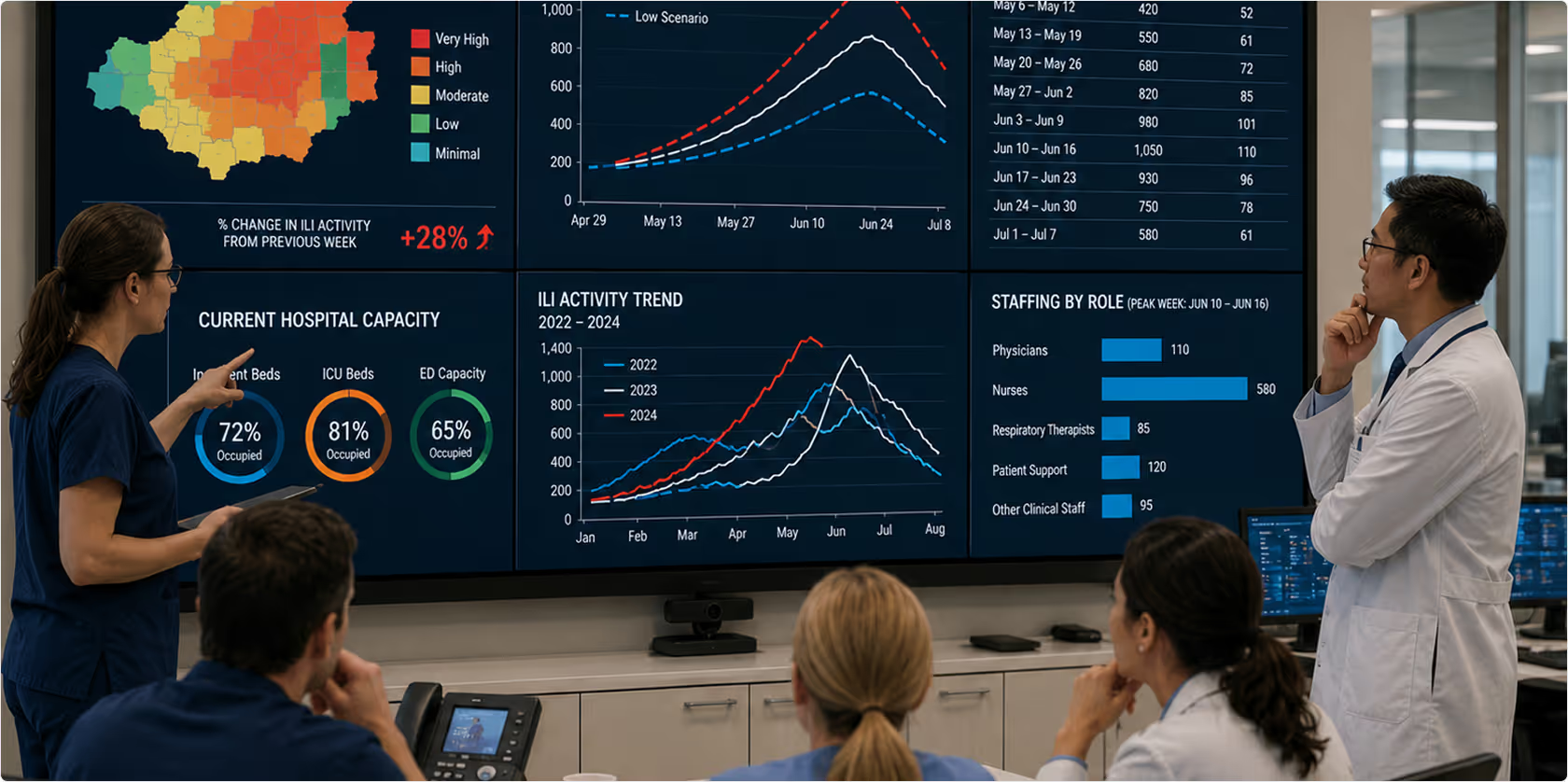
Anticipate illness-driven demand and plan staffing around regional peaks ahead of the season.
Instantly integrate Ambee Influenza-like Illness data into any workflow, available in any format.


const http = require("https");

const options = {
	"method": "GET",
	"hostname": "api.ambeedata.com",
	"port": null,
	"path": "/ili/forecast/by-lat-lng?lat=12.9889055&lng=77.574044&details=True",
	"headers": {
		"x-api-key": "API_KEY",
		"Content-type": "application/json"
	}
};

const req = http.request(options, function (res) {
	const chunks = [];

	res.on("data", function (chunk) {
		chunks.push(chunk);
	});

	res.on("end", function () {
		const body = Buffer.concat(chunks);
		console.log(body.toString());
	});
});

req.end();
const http = require('https');
const options = {
method: 'GET',
hostname: 'api.ambeedata.com',
port: null,
path: '/ili/forecast/by-lat-lng?lat=12.9889055&lng=77.574044&details=True',
headers: {
'x-api-key': 'API_KEY',
'Content-type': 'application/json'
}
};
const req = http.request(options, function (res) {
const chunks = [];
res.on('data', function (chunk) {
chunks.push(chunk);
});
res.on('end', function () {
const body = Buffer.concat(chunks);
console.log(body.toString());
});
});
req.end();OkHttpClient client = new OkHttpClient();
Request request = new Request.Builder()
.url("https://api.ambeedata.com/ili/forecast/by-lat-lng?lat=12.9889055&lng=77.574044&details=True")
.get()
.addHeader("x-api-key", "API_KEY")
.addHeader("Content-type", "application/json")
.build();
Response response = client.newCall(request).execute();using System.Net.Http.Headers;
var client = new HttpClient();
var request = new HttpRequestMessage
{
Method = HttpMethod.Get,
RequestUri = new Uri("https://api.ambeedata.com/ili/forecast/by-lat-lng?lat=12.9889055&lng=77.574044&details=True"),
Headers =
{
{ "x-api-key", "API_KEY" },
},
};
using (var response = await client.SendAsync(request))
{
response.EnsureSuccessStatusCode();
var body = await response.Content.ReadAsStringAsync();
Console.WriteLine(body);
}package main
import (
"fmt"
"net/http"
"io"
)
func main() {
url := "https://api.ambeedata.com/ili/forecast/by-lat-lng?lat=12.9889055&lng=77.574044&details=True"
req, _ := http.NewRequest("GET", url, nil)
req.Header.Add("x-api-key", "API_KEY")
req.Header.Add("Content-type", "application/json")
res, _ := http.DefaultClient.Do(req)
defer res.Body.Close()
body, _ := io.ReadAll(res.Body)
fmt.Println(res)
fmt.Println(string(body))
}<?php
$curl = curl_init();
curl_setopt_array($curl, [
CURLOPT_URL => "https://api.ambeedata.com/ili/forecast/by-lat-lng?lat=12.9889055&lng=77.574044&details=True",
CURLOPT_RETURNTRANSFER => true,
CURLOPT_ENCODING => "",
CURLOPT_MAXREDIRS => 10,
CURLOPT_TIMEOUT => 30,
CURLOPT_HTTP_VERSION => CURL_HTTP_VERSION_1_1,
CURLOPT_CUSTOMREQUEST => "GET",
CURLOPT_HTTPHEADER => [
"Content-type: application/json",
"x-api-key: API_KEY"
],
]);
$response = curl_exec($curl);
$err = curl_error($curl);
curl_close($curl);
if ($err) {
echo "cURL Error #:" . $err;
} else {
echo $response;
}curl --request GET \
--url 'https://api.ambeedata.com/ili/forecast/by-lat-lng?lat=12.9889055&lng=77.574044&details=True' \
--header 'Content-type: application/json' \
--header 'x-api-key: API_KEY'require 'uri'
require 'net/http'
url = URI("https://api.ambeedata.com/ili/forecast/by-lat-lng?lat=12.9889055&lng=77.574044&details=True")
http = Net::HTTP.new(url.host, url.port)
http.use_ssl = true
request = Net::HTTP::Get.new(url)
request["x-api-key"] = 'API_KEY'
request["Content-type"] = 'application/json'
response = http.request(request)
puts response.read_body{
"message": "success",
"data": [
{
"createdAt": "2024-08-02T00:00:00",
"lat": 37.7749,
"lng": -122.4194,
"ili_risk": "Minimal",
"pollen": {
"grass_pollen": 4,
"tree_pollen": 0,
"weed_pollen": 15,
"grass_risk": "Low",
"tree_risk": "Low",
"weed_risk": "Low"
},
"weather": {
"temperature": 33.4,
"humidity": 31,
"windSpeed": 4.15
}
},
{
"createdAt": "2024-08-03T00:00:00",
"lat": 37.7749,
"lng": -122.4194,
"ili_risk": "Minimal",
"pollen": {
"grass_pollen": 5,
"tree_pollen": 0,
"weed_pollen": 16,
"grass_risk": "Low",
"tree_risk": "Low",
"weed_risk": "Low"
},
"weather": {
"temperature": 33.61,
"humidity": 37,
"windSpeed": 4.1
}
},
{
"createdAt": "2024-08-04T00:00:00",
"lat": 37.7749,
"lng": -122.4194,
"ili_risk": "Minimal",
"pollen": {
"grass_pollen": 3,
"tree_pollen": 0,
"weed_pollen": 14,
"grass_risk": "Low",
"tree_risk": "Low",
"weed_risk": "Low"
},
"weather": {
"temperature": 32.83,
"humidity": 41,
"windSpeed": 4.47
}
},
{
"createdAt": "2024-08-05T00:00:00",
"lat": 37.7749,
"lng": -122.4194,
"ili_risk": "Minimal",
"pollen": {
"grass_pollen": 3,
"tree_pollen": 0,
"weed_pollen": 15,
"grass_risk": "Low",
"tree_risk": "Low",
"weed_risk": "Low"
},
"weather": {
"temperature": 31.93,
"humidity": 39,
"windSpeed": 4.48
}
},
{
"createdAt": "2024-08-06T00:00:00",
"lat": 37.7749,
"lng": -122.4194,
"ili_risk": "Minimal",
"pollen": {
"grass_pollen": 3,
"tree_pollen": 0,
"weed_pollen": 16,
"grass_risk": "Low",
"tree_risk": "Low",
"weed_risk": "Low"
},
"weather": {
"temperature": 31.98,
"humidity": 34,
"windSpeed": 4.77
}
},
{
"createdAt": "2024-08-07T00:00:00",
"lat": 37.7749,
"lng": -122.4194,
"ili_risk": "Minimal",
"pollen": {
"grass_pollen": 1,
"tree_pollen": 0,
"weed_pollen": 11,
"grass_risk": "Low",
"tree_risk": "Low",
"weed_risk": "Low"
},
"weather": {
"temperature": 30.62,
"humidity": 35,
"windSpeed": 4.94
}
}
]
}Sign up for an Ambee account and generate your API key from the dashboard.
Set your query parameters, including location and the forecast detail you need in the response.
Specify using latitude/longitude coordinates.
Include your API key in the request header. Receive a structured JSON response, integration-ready.
Real feedback from real innovators





.svg)














Common questions about Ambee's influenza-like Illness data
ILI API is a powerful tool that provides daily forecasts for influenza-like illness risk, along with 28-day weather and pollen data. It enables organizations to monitor and analyze flu trends.
ILI data refers to information on symptoms and cases that resemble the flu or influenza. We collect daily and historical ILI data from health surveillance systems across the state.
The ILI API allows you to access influenza-like illness risk data as well as comprehensive pollen and weather data to understand the correlation between ILI and the environment.
ILI API provides the requested area's flu risk, pollen, and weather data.
Log in to the Ambee dashboard to access the ILI API and get 100 daily API calls for free.
Factors contributing to the flu include seasonal changes, pollen levels, population density, and more. The ILI API helps to understand the relationship between influenza-like illness and environmental triggers, such as temperature, humidity, and pollen.
Flu trends (risk) can be used to forecast outbreaks, allocate healthcare resources, optimize inventory for critical medicines, and implement preventive measures to reduce the spread of influenza.
Yes, you can easily integrate the ILI API with existing health systems.