Connect Ambee to the AI assistant your team already uses
Air quality, pollen, and weather data, exposed as tools any MCP-compatible AI assistant can call directly. One server, the same API key you already have.
Air quality, pollen, and weather data, exposed as tools any MCP-compatible AI assistant can call directly. One server, the same API key you already have.


Assistants discover the available tools automatically and call the right one for a given question, resolving location and routing on the server side.

Clients read the available tools at connection time and select the right one for a given question.

Send coordinates or a place name. The server resolves it, so the client never needs a geocoding step.

Uses the same Ambee API key as REST. MCP calls and REST calls draw from the same account.

Every tool call returns data. Nothing an assistant does through MCP can modify your account.

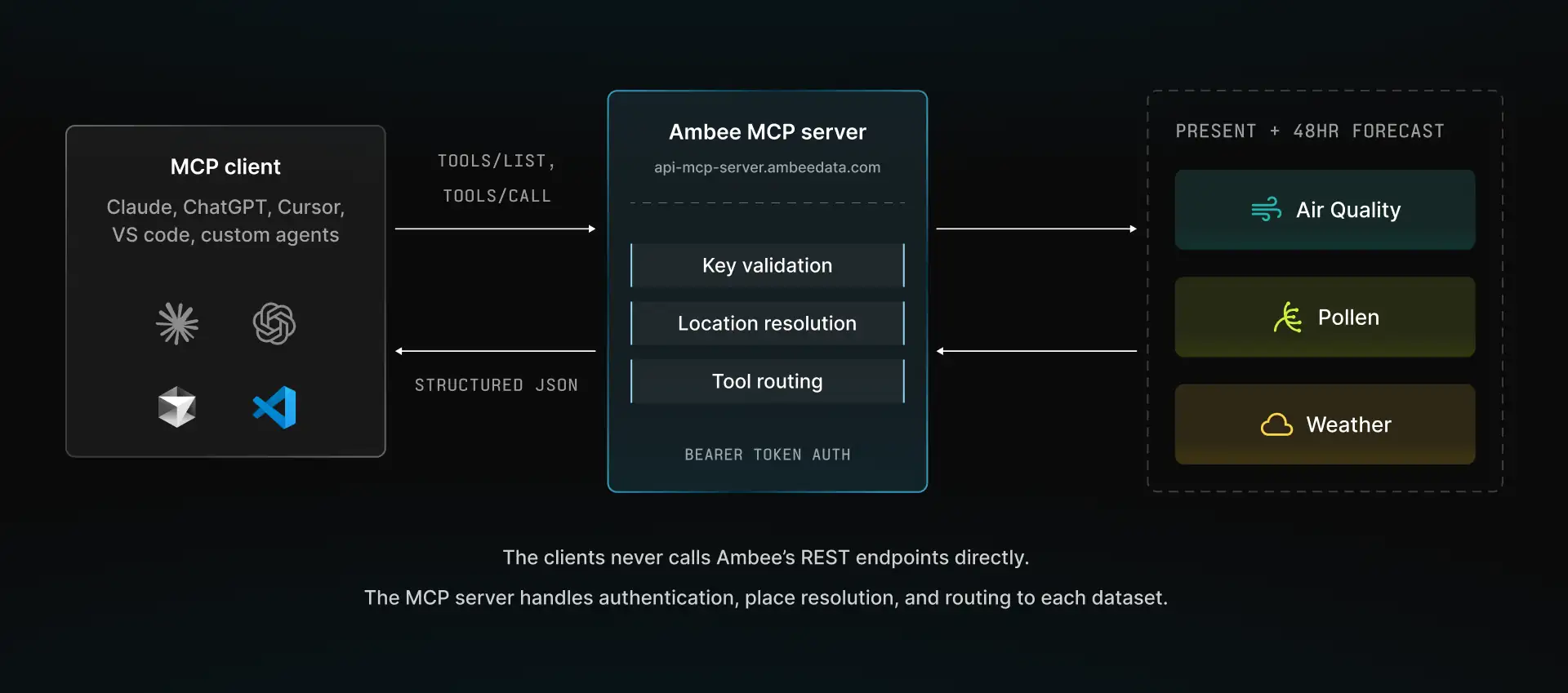
Each dataset has a present-conditions tool and a 48-hour hourly forecast tool.

Claude, ChatGPT, Cursor, VS Code, or a custom agent. The protocol is open, the server is the same.
The assistant opens a session and lists available tools.
Based on the question, it calls the matching dataset with your API key.
Key is validated, location is resolved, the right dataset is queried.
Structured JSON comes back for the assistant to read and explain.
Common questions about Ambee's MCP
The Ambee MCP server lets AI assistants pull Ambee's air quality, pollen, and weather data directly into their answers. It connects through the Model Context Protocol, an open standard for linking AI assistants to external data sources, so any MCP-compatible client can query Ambee datasets in plain language.
The Model Context Protocol, or MCP, is an open standard that lets AI assistants connect to external tools and data sources through one common interface. Anthropic released it in November 2024. Before MCP, every assistant needed its own custom integration for every data source it used.
The Ambee MCP server works with Claude, ChatGPT, Cursor, VS Code, and other MCP-compatible clients. Any client that supports the Model Context Protocol can connect to it using an Ambee API key.
Three Ambee datasets are available through the MCP server: air quality, pollen, and weather. Each returns present conditions and a 48-hour hourly forecast for locations globally.
No. The Ambee MCP server uses the same API key as Ambee's REST API, sent as a bearer token. Existing Ambee customers can connect without creating a new account or key.
Add the Ambee MCP server URL to the client's connector settings and authenticate with your Ambee API key. The assistant then reads the available tools on its own and routes questions to the right dataset. Setup steps differ slightly by client, and the Ambee documentation covers each one.
Yes. Requests through the Ambee MCP server draw on the same quota as REST requests on the same account. Usage appears alongside REST usage in your account.
Both deliver the same underlying Ambee data. REST suits applications where a developer writes the request and handles the response in code, while MCP suits AI assistants that decide which data to fetch based on what a person asks. The REST API remains fully supported.
The Ambee MCP server resolves locations on the server from coordinates, city names, or postal codes. Assistants can pass a place name the way a person said it, without converting it to coordinates first.
Teams use the Ambee MCP server to give internal assistants access to outdoor conditions, for example checking pollen forecasts before planning allergy stock, reviewing air quality at job sites before dispatching crews, or factoring conditions into activity recommendations in a health product.