Resources /
Blogs
Best flood data providers in 2026 [Complete list & comparison]
January 29, 2026
DVS Roopesh
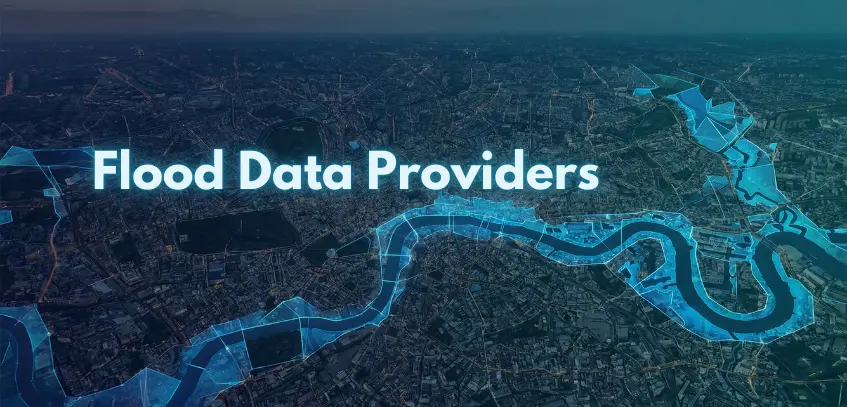
The flood data market has fragmented significantly over the past two years. Organizations now choose between multiple providers spanning AI-driven forecasting platforms, institutional catastrophe models, satellite detection systems, and hyper-local IoT networks; each optimized for different use cases, budgets, and integration requirements.
{{key-insights}}
This directory evaluates 40 flood data providers across four criteria: spatial resolution, peril coverage, API latency, and historical data depth. Whether you're building parametric insurance products, running catastrophe models, or integrating flood alerts into logistics platforms, this comparison helps you shortlist providers worth evaluating.
One trend worth noting in 2026 is the emergence of multi-hazard API platforms that bundle flood data with adjacent environmental datasets. Ambee represents this approach, their single integration point covers flood, weather, air quality, pollen, and wildfire data, which reduces vendor management overhead for teams building comprehensive climate applications.
The trade-off is that specialized flood providers like Fathom or JBA typically offer deeper actuarial tooling and peer-reviewed methodology that pure-play insurance use cases may require. Your choice depends on whether integration simplicity or flood-specific depth matters more for your use case.
This category represents the cutting edge of operational flood intelligence, leveraging machine learning, digital twins, and real-time data streams to deliver actionable forecasts at unprecedented temporal and spatial granularity for flood early warning systems.
What it is: The unified environmental intelligence platform offering real-time and historical flood data via a single API, covering pluvial, fluvial, and coastal flood events alongside air quality, pollen, weather, and wildfire data.
Standout feature: Multi-hazard API architecture that recognizes flood risk rarely exists in isolation. Antecedent soil moisture, precipitation patterns, and wildfire-induced watershed changes all influence flood behavior. Developers integrate once and access correlated hazard insights impossible with siloed providers.
Best for: Climate risk platforms, ESG dashboards, fintech applications, smart city developers, and any enterprise needing quick-deploy, globally consistent flood insights integrated with a comprehensive environmental context.
Website: https://www.getambee.com/api/flood
What it is: Google's AI-powered flood forecasting system providing riverine flood predictions across 100+ countries using machine learning trained on historical flood events.
Standout feature: ML models delivering 7-day advance forecasts without requiring traditional hydraulic infrastructure or local gauge networks.
Best for: Government agencies and NGOs in developing regions lacking dense monitoring networks.
Website: https://sites.research.google/floods/
What it is: Real-time monitoring platform for global infrastructure networks with comprehensive coverage of all flood types.
Standout feature: 72-hour forecasts covering pluvial, fluvial, and coastal flooding with hourly updates and site-specific risk scoring.
Best for: Infrastructure operators, logistics companies, and supply chain risk managers.
Website: https://7analytics.ai/products/real-time/
What it is: Property-level flood forecasting platform with depth and duration predictions integrated with IoT sensor networks.
Standout feature: 48-hour property-level forecasts with precise depth and duration prediction for individual assets.
Best for: Commercial real estate owners, facility managers, and insurers with concentrated exposures.
Website: https://previsico.com/
What it is: Real-time street-level flood prediction system designed for municipal emergency management deployments.
Standout feature: Street and house-level forecasting with 3-4 day advance warning and hourly rainfall ingestion.
Best for: Municipal emergency managers and urban planning departments.
Website: https://streamline.tech/floodwise
What it is: Live inundation nowcasting platform providing real-time flood extent visualization during active events.
Standout feature: Rapid deployment of inundation maps during unfolding flood events for operational response.
Best for: Emergency responders and disaster coordination centers during active flood events.
Website: https://www.floodmapp.com/
What it is: A global hydro-meteorological forecasting system powered by MIKE hydraulic modeling technology with daily updates.
Standout feature: Physically-based hydraulic modeling trusted by engineering consultancies for detailed flood studies and digital twin development.
Best for: Engineering consultancies requiring physics-based models for regulatory submissions.
Website: https://www.dhigroup.com/technologies/global-hydrological-model
What it is: Integrated flood early warning system platform deployed in 40+ countries for national meteorological and hydrological services.
Standout feature: Real-time monitoring with probabilistic ensemble forecasts and multi-hazard capability.
Best for: National meteorological services building sovereign early warning capabilities.
Website: https://www.deltares.nl/en/software-and-data/products/delft-fews-platform
What it is: AI-powered flood risk intelligence platform combining multiple data sources for unified portfolio views.
Standout feature: Machine learning-driven data fusion from heterogeneous flood data sources.
Best for: Organizations seeking unified views across geographically diverse portfolios.
Website: https://www.birdseyeview.ai/
What it is: Climate risk scoring platform with property-level flood ratings for real estate transactions.
Standout feature: Consumer-friendly flood risk scores designed for real estate disclosure requirements.
Best for: Real estate investors, mortgage lenders, and property disclosure platforms.
Website: https://climatecheck.com/risks/flood
What it is: Forward-looking flood risk projections under multiple climate scenarios for financial stress testing.
Standout feature: Climate scenario analysis aligned with TCFD and NGFS frameworks for regulatory reporting.
Best for: Financial institutions conducting climate stress testing and scenario analysis.
Website: https://www.mitigasolutions.com/
These providers deliver enterprise-grade flood hazard data designed for insurance underwriting, catastrophe modeling, and regulatory compliance. Their datasets undergo rigorous scientific validation and typically offer deep historical backtesting capabilities for hydraulic modeling calibration.
What it is: A research-backed global flood hazard mapping platform covering 255+ countries with a peer-reviewed methodology developed in partnership with the University of Bristol.
Standout feature: 10-meter spatial resolution across pluvial, fluvial, and coastal flood layers with integrated climate change scenarios and probabilistic return period modeling.
Best for: Insurance underwriters requiring scientifically-defensible hazard data for portfolio pricing and catastrophe model calibration.
Website: https://www.fathom.global/
What it is: Institutional-grade catastrophe models integrating flood hazard with vulnerability functions and financial loss estimation across all countries.
Standout feature: 10-meter resolution hazard grids coupled with proprietary damage functions calibrated against decades of insurance claims data for loss ratio optimization.
Best for: Reinsurers and large commercial insurers running regulatory capital models (Solvency II, RBC).
Website: https://www.moodys.com/web/en/us/capabilities/catastrophe-modeling/flood-models.html
What it is: Comprehensive flood risk solutions, including hazard maps, depth-damage curves, and climate scenario modeling from a dedicated flood specialist known as "The Flood People."
Standout feature: Integrated impact models with actuarial consulting support for bespoke loss estimation and portfolio analytics.
Best for: Insurance pricing teams requiring both data and actuarial consulting for flood peril.
Website: https://www.jbarisk.com/products/data/
What it is: AIR's inland flood models covering pluvial and fluvial perils with stochastic event sets for probabilistic loss analysis within the catastrophe modeling ecosystem.
Standout feature: Deep integration with Touchstone catastrophe modeling platform, enabling seamless multi-peril analysis.
Best for: Existing Verisk customers adding flood to multi-hazard cat modeling workflows.
Website: https://www.verisk.com/products/inland-flood-models/
What it is: Site-specific flood risk assessment platform with loss estimation models and GIS integration for property-level screening.
Standout feature: Connection to Precisely's broader location intelligence suite for enriched risk scoring across multiple perils.
Best for: Commercial property underwriters requiring rapid site-specific screening.
Website: https://www.precisely.com/data-guide/products/flood-risk
What it is: Publicly-accessible flood hazard visualization tool backed by FM Global's 200+ years of engineering expertise and loss prevention research.
Standout feature: Integration with Natural Hazard Toolkit covering earthquake, wind, and flood perils for holistic exposure assessment.
Best for: Risk engineers conducting preliminary exposure assessments for commercial properties.
Website: https://www.fm.com/resources/nathaz-toolkit/flood
What it is: Multi-peril hazard data provider with expanded flood capabilities following the Symfos acquisition.
Standout feature: Flexible licensing for custom catastrophe model development outside major vendor ecosystems.
Best for: MGAs and specialty insurers building custom cat models.
Website: https://www.katrisk.com/hazard-data/
What it is: Property risk data aggregator integrating FEMA flood zones with 100+ other hazard attributes for instant risk assessment.
Standout feature: Native integration with the Guidewire policy administration platform for automated underwriting workflows.
Best for: Guidewire platform customers seeking turnkey hazard data enrichment.
Website: https://www.guidewire.com/products/analytics/hazardhub-risk-data
What it is: Risk analytics platform delivering flood risk assessment, exposure analysis, and loss estimation with quarterly model updates.
Standout feature: Quarterly refresh cycle ensuring hazard layers reflect recent flood events and updated terrain data.
Best for: Risk managers needing periodic portfolio reviews and accumulation monitoring.
Website: https://saferplaces.co/
Satellite-derived flood products provide the observational backbone for model validation, near real-time event detection at a global scale, and independent verification for parametric insurance triggers.
What it is: Near real-time flood detection using VIIRS satellite data at 250-meter resolution from NASA Earthdata.
Standout feature: Daily global coverage with open data access for research and humanitarian applications.
Best for: Researchers and humanitarian organizations tracking global flood events.
Website: https://www.earthdata.nasa.gov/data/instruments/viirs/near-real-time-data/nrt-global-flood-products
What it is: Historical archive of 15+ years of satellite-derived flood events with impact analysis.
Standout feature: Comprehensive historical flood footprints for model validation and backtesting.
Best for: Catastrophe modelers validating against historical observations and climate researchers.
Website: https://global-flood-database.cloudtostreet.ai/
What it is: Satellite-based water surface elevation and flood extent mapping with integrated water quality monitoring.
Standout feature: Combined hydrology and water quality analysis from a single earth observation platform.
Best for: Environmental consultancies requiring integrated water monitoring solutions.
Website: https://eomap.com/services/hydrology/
What it is: Satellite-powered flood intelligence designed specifically for parametric insurance applications.
Standout feature: Independent event verification using satellite imagery for parametric trigger validation.
Best for: Parametric insurance carriers and NGO relief organizations requiring independent flood verification.
Website: https://www.floodbase.com/
What it is: Ocean and coastal risk data platform focusing on storm surge and coastal inundation hazards.
Standout feature: Specialized coastal flood modeling, including storm surge and sea level rise scenarios.
Best for: Port authorities, coastal infrastructure operators, and marine insurance underwriters.
Website: https://www.ocean-ledger.com/
What it is: GIS-based flood risk tools with native ArcGIS integration and 3D visualization capabilities.
Standout feature: Seamless integration with the ArcGIS ecosystem, including 3D flood visualization and climate change modeling tools.
Best for: GIS teams in government agencies already using Esri for spatial data management.
Website: https://www.esri.com/en-us/disaster-response/disasters/flooding
Ground-truth sensor networks provide the highest temporal resolution data for validating hydraulic models, triggering automated flood responses, and supporting local emergency management operations.
What it is: Authoritative real-time hydrological monitoring network spanning 13,000+ stations across the United States.
Standout feature: Real-time streamflow, water level monitoring, and discharge measurements with decades of historical records.
Best for: US-focused flood modelers requiring authoritative gauge data for model calibration.
Website: https://waterdata.usgs.gov/
What it is: IoT-powered flood monitoring platform with sensor network management and automated alert systems.
Standout feature: End-to-end sensor deployment with real-time dashboards and automated warning dissemination.
Best for: Municipal governments deploying smart city flood monitoring infrastructure.
Website: https://aurassure.com/flood-monitoring_aurassure-aqua/
What it is: Public alert dissemination system with SMS/push notifications and evacuation routing for California residents.
Standout feature: Real-time targeted alerts with evacuation routing integrated into public warning systems.
Best for: California emergency managers and residents in flood-prone areas.
Website: https://alertcalifornia.org/
What it is: Environmental monitoring solutions for infrastructure protection with integrated flood risk management.
Standout feature: Combined environmental monitoring covering flood, weather, and air quality for facility management.
Best for: Facility managers requiring integrated environmental monitoring systems.
Website: https://aem.eco/solution/flood-risk-management/
What it is: Property-level FEMA flood zone determination integrated with comprehensive property data.
Standout feature: FEMA flood zone data enriched with property characteristics for lending compliance.
Best for: Mortgage lenders and real estate platforms requiring NFIP compliance data.
Website: https://www.attomdata.com/data/hazard-risk-data/flood-zone/
What it is: River network and watershed boundary data for hydrological analysis and flood modeling.
Standout feature: Authoritative stream network topology for watershed delineation and drainage analysis.
Best for: Hydrologists requiring authoritative stream network data for basin modeling.
Website: https://www.snapnhd.com/
What it is: UK groundwater flood forecasting service for areas with chalk and limestone geology.
Standout feature: Specialized groundwater flood prediction for geological conditions prone to rising water tables.
Best for: UK developers and insurers in chalk and limestone geologies susceptible to groundwater flooding.
Website: https://geosmartinfo.co.uk/data-and-services/groundwater-flood-forecasting/
Regional and national systems often provide the highest-quality flood data for specific jurisdictions, while specialized providers address niche use cases, including historical disaster databases and professional hydraulic modeling software.
What it is: Copernicus service providing 30-day global river flood forecasts and seasonal streamflow outlooks.
Standout feature: Medium-range (30-day) probabilistic flood forecasts for global river basins.
Best for: International organizations requiring medium-range flood outlooks for humanitarian planning.
Website: https://global-flood.emergency.copernicus.eu/
What it is: Pan-European flood forecasting system with a 15-day forecast horizon and flash flood risk assessment.
Standout feature: 15-day forecast horizon with daily updates and specialized flash flood early warning.
Best for: European meteorological services and civil protection authorities.
Website: https://www.copernicus.eu/en/european-flood-awareness-system
What it is: Historical database of 27,000+ disasters from 1900 to present with comprehensive loss data.
Standout feature: Century-spanning disaster records for long-term flood trend analysis and model validation.
Best for: Researchers studying long-term flood trends and climate scientists.
Website: https://www.emdat.be/
What it is: Japan's national flood forecasting system with dense monitoring networks and real-time warning systems.
Standout feature: Real-time river flood forecasts with integrated rainfall monitoring from one of the world's densest gauge networks.
Best for: Organizations with Japan-specific flood exposures requiring authoritative national data.
Website: https://www.jma.go.jp/jma/en/Activities/forecast.html
What it is: Australian national flood monitoring and forecasting service with real-time river levels and satellite monitoring.
Standout feature: Real-time river level monitoring across Australia's major river systems with flood class thresholds.
Best for: Agricultural insurers and water utilities operating in Australia.
Website: https://www.bom.gov.au/water/floods/index.shtml
What it is: UK environmental risk data provider for property transactions, including comprehensive flood risk reports.
Standout feature: Integrated environmental search reports combining flood risk with contaminated land and subsidence data.
Best for: UK conveyancing solicitors and property search companies.
Website: https://www.groundsure.com/products/flood-product-page/
What it is: Professional hydraulic modeling software for detailed flood studies and engineering analysis.
Standout feature: Industry-standard 1D/2D hydraulic engine for detailed flood mapping and infrastructure design.
Best for: Engineering consultancies conducting detailed flood studies for regulatory approval.
Website: https://www.floodmodeller.com/fathom
The optimal flood data provider depends on your specific use case, geographic scope, and integration requirements. Consider these factors when evaluating options:
For enterprise climate applications: Prioritize providers offering unified multi-hazard APIs with consistent data schemas. Ambee's platform enables developers to access flood intelligence alongside correlated weather, air quality, pollen, and wildfire data; eliminating the complexity of managing multiple vendor relationships.
For insurance underwriting: Look for providers with peer-reviewed methodology, probabilistic return periods, and depth-damage curves. Fathom Global, JBA Risk Management, and Moody's RMS offer the scientific defensibility required for regulatory capital models.
For real-time operations: Focus on API latency, update frequency, and IoT integration. 7Analytics, Previsico, and FloodMapp deliver the temporal granularity needed for operational response.
For parametric insurance: Satellite-based providers like Floodbase offer independent event verification essential for parametric trigger validation.
As climate change intensifies flood frequency and severity globally, investment in robust flood intelligence has shifted from a competitive advantage to an operational necessity. The 40 providers cataloged in this directory represent the current state of the art in flood data, from institutional catastrophe models to AI-driven forecasting platforms and satellite-based detection systems.
For a complete overview of environmental data options, explore our guides to the best weather APIs and best air quality APIs.
Ready to integrate unified flood intelligence into your climate-aware applications? Ambee's Flood API delivers real-time monitoring, historical event data, and risk assessment through a single developer-friendly integration alongside air quality, weather, pollen, and wildfire data.
00:00
/
00:00
00:00
/
00:00
00:00
/
00:00
00:00
/
00:00