Resources /
Blogs
A generation eager to heal the planet now has the data
December 11, 2025
Pareekshith Katti

When speaking with Didier Clabaut, a lecturer at Thomas More University, we realized that educators are now encouraging students to integrate environmental data into class projects. With Ambee's real-time climate APIs, students and researchers worldwide gain access to accurate, reliable data that was once available only to top scientists and government institutions.
{{key-insights}}
A Reddit user once answered the question, “What do you think is the most important role of a teacher?” with a single word: A facilitator.
I'm there to help students on their journey of learning. I'm not there to lecture them. I want to provide them with an outline, and then see them grow.
Exploration over instruction. That is the philosophy of many modern educators.
One such professor is Didier Clabaut, a lecturer at Thomas More University, who believes real growth comes from giving students freedom, context, and the right tools to experiment.
Every year, he assigns practical data-related projects, and in 2025, he encouraged his students to use Ambee's climate data to create mobile applications that could genuinely help people.
When we spoke with him about how his students brought environmental data to life through their projects, one statement clearly reflected his teaching approach:
Each year, our students receive an open assignment in which they are allowed to come up with their own group project. During the introduction presentation, I talk about some of the challenges that the world is facing, and I invite them to come up with solutions to them.
Didier’s drive to inspire real-world impact is supported by Ambee’s easily accessible climate data, which helps students connect their creativity with the realities of our changing climate.
Encouraging hands-on learning is easy to say, but harder to put into practice.
Most students want to think beyond the textbook. The challenge begins when they move from fixed exercises to open-ended, real-world projects.
To build something that works in the real world and that people can genuinely use, students need data they can trust.
Yet this is often where students and researchers hit a wall.
Most publicly available datasets are prone to being messy, incomplete, or difficult to integrate into even the simplest systems.
Many are built for enterprise-scale applications and priced accordingly, leaving most students without affordable access to reliable information.
Even when data is available, it tends to be generic, featuring broad averages rather than hyperlocal insights. This limits creativity and makes it difficult for student developers to design experiences that feel truly personal.
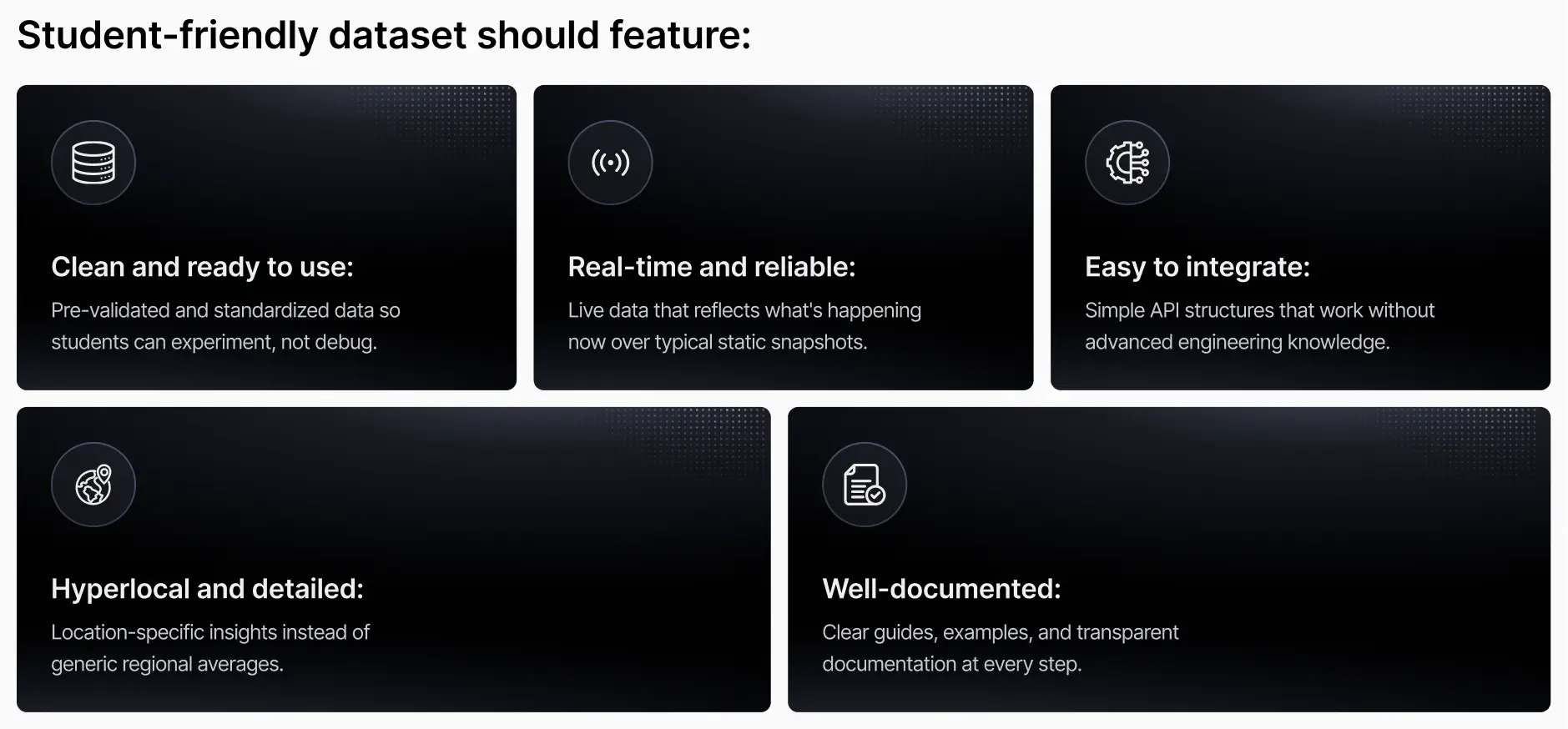
According to data scientists, including Ambee's team, student-friendly datasets should be:
Exposure to real data does more than build confidence. As Mr. Clabaut highlighted,
Young people are concerned about the environment but feel like they lack the tools to make any impact. Having real-life data is key to giving them a kickstart.
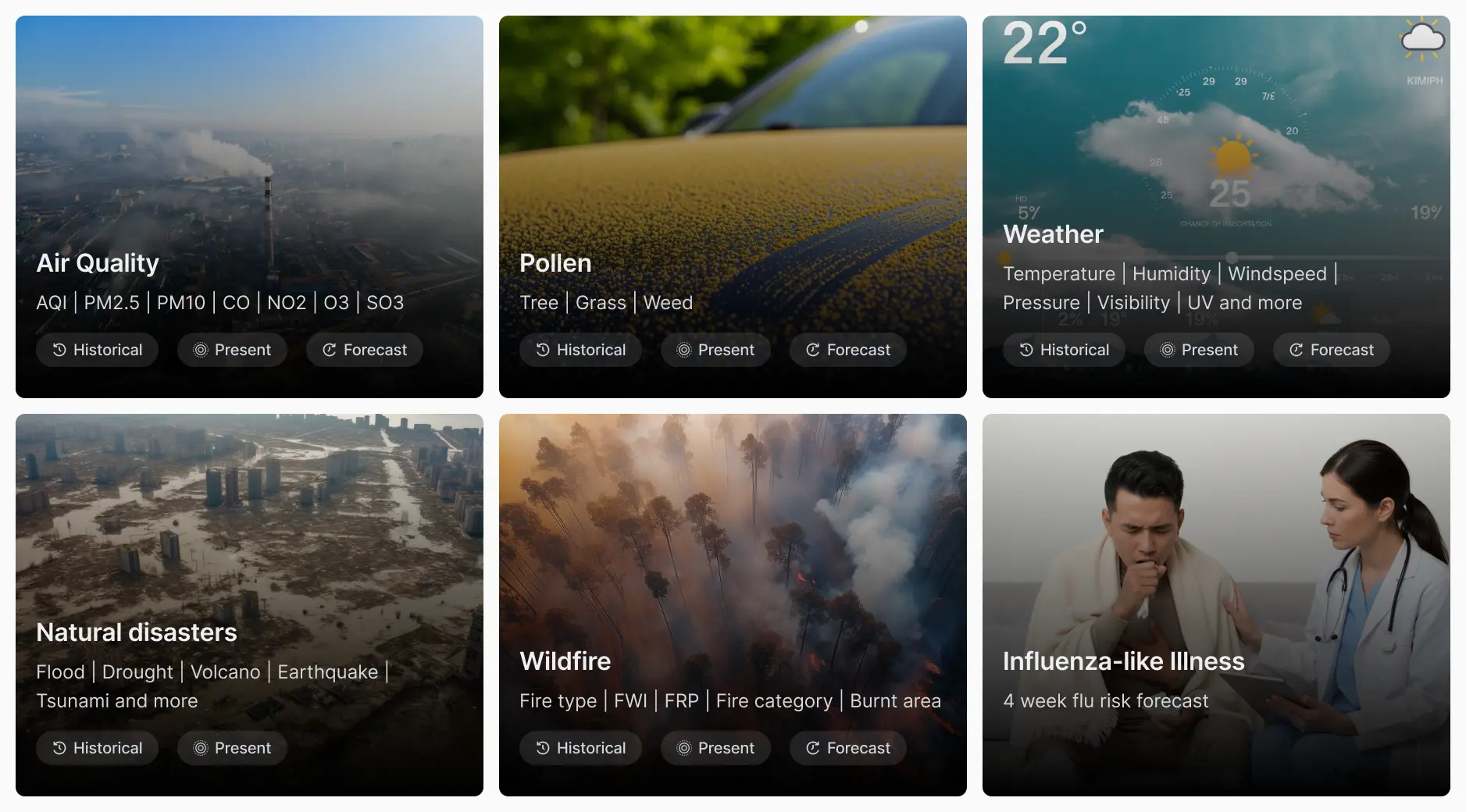
From temperature, humidity, and pressure to pollen levels and pollutant concentrations, Ambee’s climate data APIs deliver hyperlocal, multi-parameter data for any location in the world.
Whether a project focuses on Antwerp or Amsterdam, the same quality of information is available at every query. Students can build applications that reflect real environmental conditions, and access over 30 years of historical records to study change over time.
Senior Lecturer in Applied Sport and Performance at Manchester Metropolitan University, Dr. Naomi Datson, recognized the potential of this abundance of environmental data.
Working with an elite football club based in London, she used five years of Ambee’s actionable climate data to map international match venues and schedules with detailed insights on temperature, humidity, air quality, precipitation, and pollen counts.
With this knowledge, players could adjust their training to warmer or colder climates, manage allergy risks, and reduce environmental surprises that might affect their performance or recovery.
We spoke to her about how environmental data is becoming an integral part of sports performance, shaping both physical and psychological readiness.
We asked Professor Clabaut what inspired him to bring environmental data into his classroom projects.
Our students received an assignment for a mobile application that displays information from an online API. I wanted to make the application relevant for the students, to give them a sense of the impact that they will make on the future.
Like any typical class, Clabaut’s batch at Thomas More University had a mix of skill levels. Some were confident coders, others were still learning the basics.
At Ambee, we want to make it easier for students to turn curiosity into creation. That’s why our data is designed to be simple to plug in, yet powerful enough to deliver customized results.
Through our collaboration with NASA’s PACE mission, Ambee has access to over two decades of satellite records and live environmental data. This information is validated by scientists, cross-checked with ground-based observations, and standardized into a format that anyone can use seamlessly across the globe.
What was once information available only to premier scientists and government programs is now within reach for students, educators, and innovators everywhere in a way that makes sense to them.
For students, this means they no longer have to depend on static, outdated, or incomplete datasets. Instead, they can access live, accurate environmental data that reflects the real world as it changes.
If a team wants to create a feature that helps users understand air quality in their neighborhood, Ambee’s hyperlocal data delivers precise, location-specific readings rather than broad regional averages.
And for students building personalized weather or health tools, our well-documented APIs, available at docs.ambeedata.com, make integration fast and frustration-free.
The impact of this accessibility was clear to Professor Clabaut and his students. When asked why he chose Ambee’s API for this project, he shared:
It was easy to use and covered everything we needed in one place. There wasn’t a lot of ready-made code available online, which made it even more valuable as a learning experience.
Professor Clabaut noted that the first challenge his students had to overcome was simply learning how to work with an API. This is the case for many beginner developers.
For academics, researchers, or educators unsure where to begin, don’t sweat the technical details. The process is simpler than it seems. Here’s a quick walkthrough to help you get started with Ambee APIs:
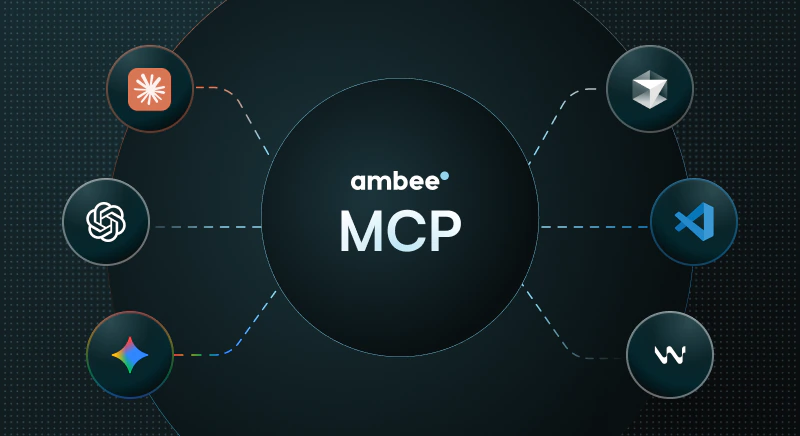
Designed with developers in mind, Ambee’s APIs are delivered in flexible JSON format and support multiple programming languages. Integration is straightforward, whether you’re working through code or via platforms like Zapier.
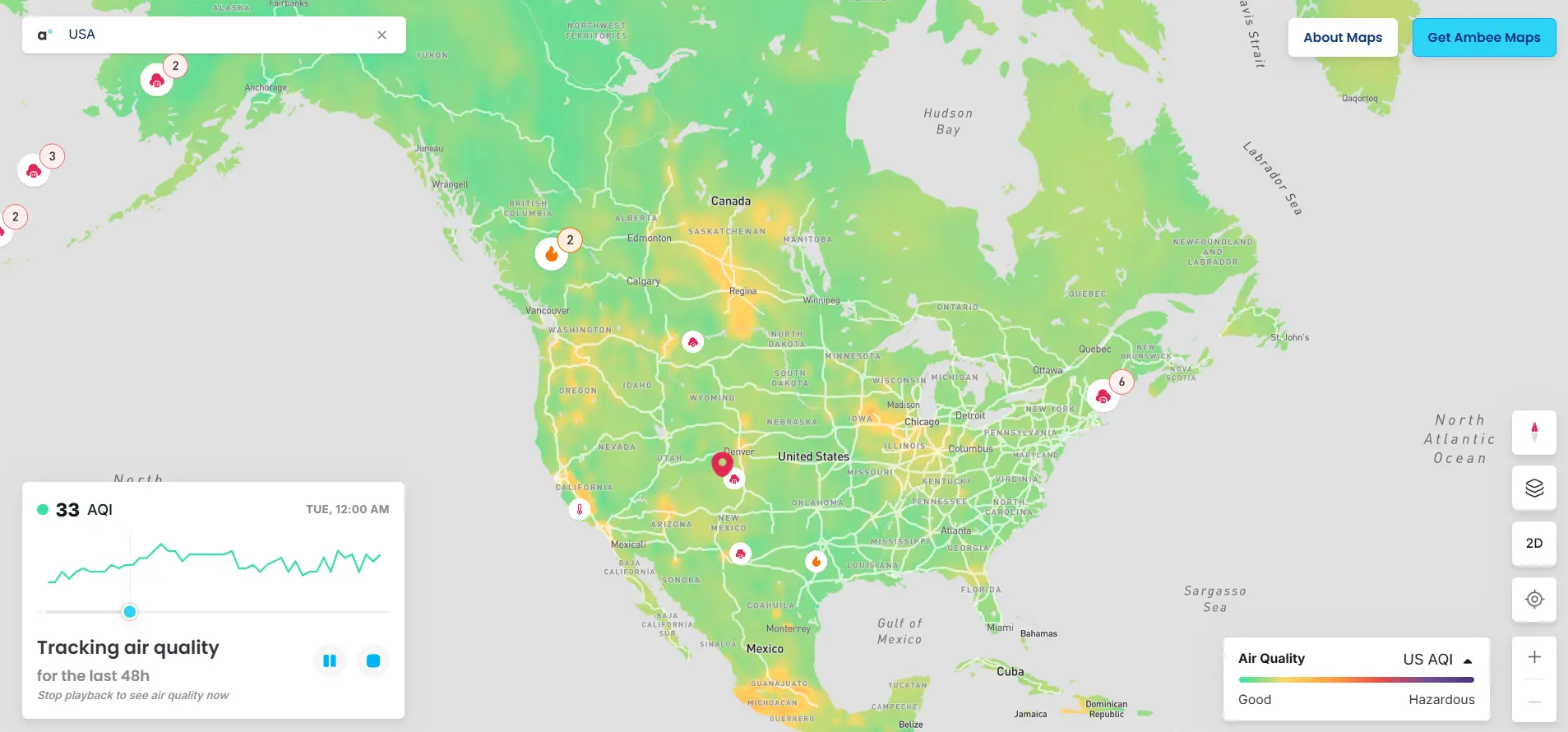
Students are the future of every industry, and they know it.
In 2019, there were 515 student-run companies. By 2022, that number had grown to 4,093. Most of these founders are between 18 and 25, and are blending textbook education with real-world experimentation.
Professor Clabaut sees that energy firsthand:
We have more and more students who already start their own business while at school. They are at the peak of their creativity and find value in a combination of technologies and online sources that others would never think of.
He believes that marriage between academia and technology companies like Ambee is where the next big ideas will grow.
Academia, he says, needs industry to stay connected to real-world challenges, while industry needs academia as fertile ground where new ideas can take root.
We thank Professor Clabaut and his students for sharing their experience and for reminding us how learning thrives when curiosity meets opportunity.
With Ambee, learners get instant access to a living stream of environmental intelligence that can inspire those ideas.
If your institution or research program is exploring data-driven innovation, we invite you to learn more about the Ambee for Academia Program!
00:00
/
00:00
00:00
/
00:00
00:00
/
00:00
00:00
/
00:00