Resources /
Blogs
The best weather forecast models of 2026: Expert picks!
January 5, 2026
DVS Roopesh
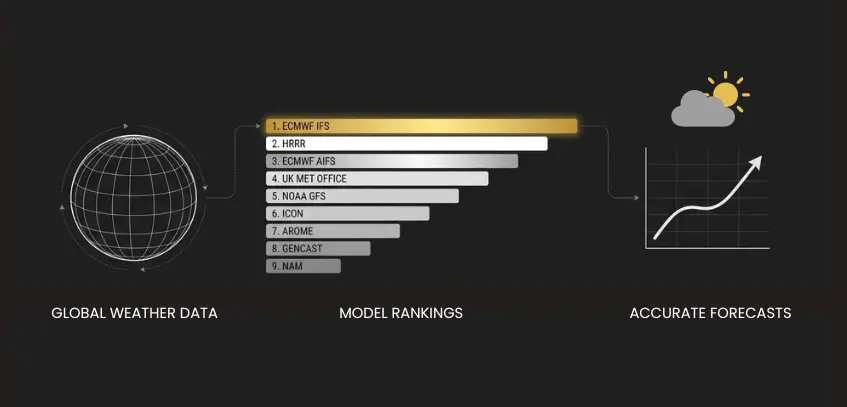
Which weather model gives the most accurate forecasts? We ranked the top prediction models using verified 2026 accuracy data from ECMWF, NOAA, and WMO.
ECMWF IFS is the most accurate weather prediction model in 2026. It maintains a one-day accuracy advantage over competitors, meaning its 6-day forecast matches the accuracy of other models' 5-day forecasts.
For short-range accuracy (0 to 48 hours), HRRR leads in the US, while AROME leads in Western Europe.
Developer: European Centre for Medium-Range Weather Forecasts
Resolution: 9 km with 137 vertical levels
Forecast range: 15 days
Data access: Partial free/Licensed
Why it's #1: ECMWF's Cycle 49r1 (November 2024) pushed useful forecast skill past 10 days for the first time. WMO verification data consistently show ECMWF leading all other global models in anomaly correlation scores, the standard measure of forecast accuracy.
2026 Accuracy stats: ECMWF maintains approximately one day of accuracy advantage over competitors. Its 51-member ensemble system provides the most reliable probability forecasts for extreme weather events.
Best for:
Limitations:
Developer: NOAA/NCEP
Resolution: 3 km
Forecast range: 48 hours
Data access: Free
Why it ranks high: HRRR updates every hour and ingests radar data every 15 minutes. This means if a storm is forming right now, the next HRRR run captures it, something no global model can match.
2026 Accuracy stats: For thunderstorm timing and location within 18 hours, HRRR consistently outperforms all global models. Its 3 km resolution explicitly resolves individual storm cells rather than estimating them.
Best for:
Limitations:
Developer: ECMWF
Resolution: 28 km
Forecast range: 15 days
Data access: Experimental/Research
Why it ranks high: AIFS became the first operational AI weather model in February 2025. It shows roughly 10% better accuracy than traditional physics models for large-scale patterns, with 20% improvement in tropical cyclone track predictions.
2026 Accuracy stats: Lower root-mean-square error than physics-based IFS for upper-air variables. Runs 1,000 times faster, enabling rapid ensemble generation.
Best for:
Limitations:
Developer: UK Met Office
Resolution: 10 km global/1.5 km over UK
Forecast range: 7 days
Data access: Partially free
Why it ranks high: Consistently ranks second globally after ECMWF in WMO verification. Excels at Atlantic storm systems and European weather patterns.
2026 Accuracy stats: Often matches or beats GFS in 5-day forecast accuracy. Its UKV nest provides exceptional 1.5 km detail for UK-specific forecasts.
Best for:
Limitations:
Developer: NOAA/NCEP
Resolution: 13 km
Forecast range: 16 days
Data access: Completely free
Why it ranks high: GFSv16 significantly improved hurricane track and precipitation accuracy. The gap with ECMWF has narrowed substantially since 2021.
2026 Accuracy stats: Trails ECMWF by approximately one day of forecast skill. However, runs 4 times daily (vs ECMWF's 2), providing fresher data for rapidly evolving situations.
Best for:
Limitations:
Developer: DWD (German Weather Service)
Resolution: 13 km global/6.5 km Europe/2.2 km Germany
Forecast range: 7.5 days
Data access: Free (open source)
Why it ranks high: ICON's triangular grid handles complex terrain better than traditional models. Its non-hydrostatic core explicitly simulates vertical air motions that other models approximate.
2026 Accuracy stats: Outperforms global competitors for Alpine weather, valley winds, and orographic precipitation. The 2.2 km ICON-D2 nest rivals any regional model for Central European convective storms.
Best for:
Limitations:
Developer: METEO-France
Resolution: 1.3 km
Forecast range: 42 hours
Data access: Restricted
Why it ranks high: At 1.3 km, AROME is among the finest-resolution operational models anywhere. It explicitly resolves thunderstorms without relying on approximations.
2026 Accuracy stats: Superior to global models for Mediterranean flash flood prediction, urban heat effects, and thunderstorm timing within 24 hours.
Best for:
Limitations:
Developer: Google DeepMind
Resolution: 28 km (0.25°)
Forecast range: 15 days
Data access: Research/experimental
Why it ranks high: GenCast uses diffusion modeling to generate full probability distributions rather than single forecasts. Testing against ECMWF's operational ensemble showed GenCast to be more accurate on 97.2% of verification targets, rising to 99.8% beyond 36 hours.
2026 Accuracy stats: Each 15-day ensemble member runs in approximately 8 minutes on cloud TPU. Produces calibrated uncertainty estimates that traditional ensemble systems struggle to match.
Best for:
Limitations:
Developer: NOAA/NCEP
Resolution: 12 km parent, 3 km nests
Forecast range: 84 hours (3.5 days)
Data access: Free
Why it ranks high: NAM bridges the gap between HRRR's short-range and global model resolution. Its 3 km nests provide high-resolution guidance through 60 hours—longer than HRRR's standard runs.
2026 Accuracy stats: Provides a valuable "second opinion" for severe weather at days 2 to 3. Strong performance for cold air damming, Appalachian weather, and lake-effect snow setups.
Best for:
Limitations:
Weather centers use standardized metrics to compare model performance:
Anomaly Correlation (ACC): Measures how well the model captures large-scale weather patterns. A score above 0.8 is considered skillful. ECMWF maintains ACC above 0.8 past day 10.
Root Mean Square Error (RMSE): Measures average prediction error. Lower is better. AI models like AIFS now achieve lower RMSE than physics models for upper-air variables.
Equitable Threat Score (ETS): Measures precipitation forecast accuracy. Physics models still lead AI models for heavy rainfall events.
These metrics are only one piece of forecast quality. The full pipeline behind every prediction, from satellite observations through supercomputer simulation to human forecaster judgment, is covered in our guide on how meteorologists predict the weather.
Professional forecasters never rely on one model. Each has blind spots:
The most accurate forecasts combine multiple models with bias correction. Platforms like Ambee Weather API aggregate data from GFS, ECMWF, satellite imagery, and ground sensors. Machine learning algorithms automatically select the best-performing model for each location and correct known biases, delivering accuracy that exceeds any single model alone.
For enterprise users, this eliminates the complexity of model selection while maximizing forecast accuracy through intelligent data fusion.
The answer depends on your timeframe and location:
The most important insight: No single model wins in all situations. The truly most accurate approach combines multiple sources with intelligent bias correction, which is exactly what modern aggregation platforms deliver.
For enterprise users, this means accuracy without complexity. For individual forecasters, it means consulting multiple models and understanding each one's strengths. For everyone, it means better predictions than any single model could provide alone.
00:00
/
00:00
00:00
/
00:00
00:00
/
00:00
00:00
/
00:00