Resources /
Blogs
How to Time Allergy HCP Calls Using Climate Intelligence
August 28, 2026
Anshu Singh

How pharma commercial teams can layer climate intelligence into existing HCP engagement plans without replacing a single system to stop missing engagement timing windows in allergy, asthma, and upper respiratory prescriptions.
There's a gap most commercial leaders in respiratory and allergy Rx quietly acknowledge but rarely name directly.
The pharma field team knows the pollen season is shifting. The brand team has seen the data on climate-driven prescription variability. Medical affairs knows allergic rhinitis (AR) is increasingly year-round, not just spring and fall. And yet, call plans still get locked quarterly. Territory priorities still default to last year's deciles or historical averages. Campaign calendars still align to budget cycles, not to the week when grass pollen in the Midwest crosses the threshold that sends patients to their GP.
That gap between what teams know and what the commercial structure actually responds to is where revenue leaks, season after season. Not catastrophically. Just like regional inconsistency, campaign underperformance, and "unpredictable" patterns that nobody can quite explain.
This blog is about closing that gap. Specifically, it's about how to layer climate intelligence on top of what you already have without restructuring your CRM, retraining your field force, or renegotiating your call plan commitments.
Most pharma categories have relatively stable patterns. Chronic disease maintenance, oncology, and diabetes prescribing are mostly driven by diagnosis prevalence, patient load, and physician habit. Environmental timing barely enters the picture.
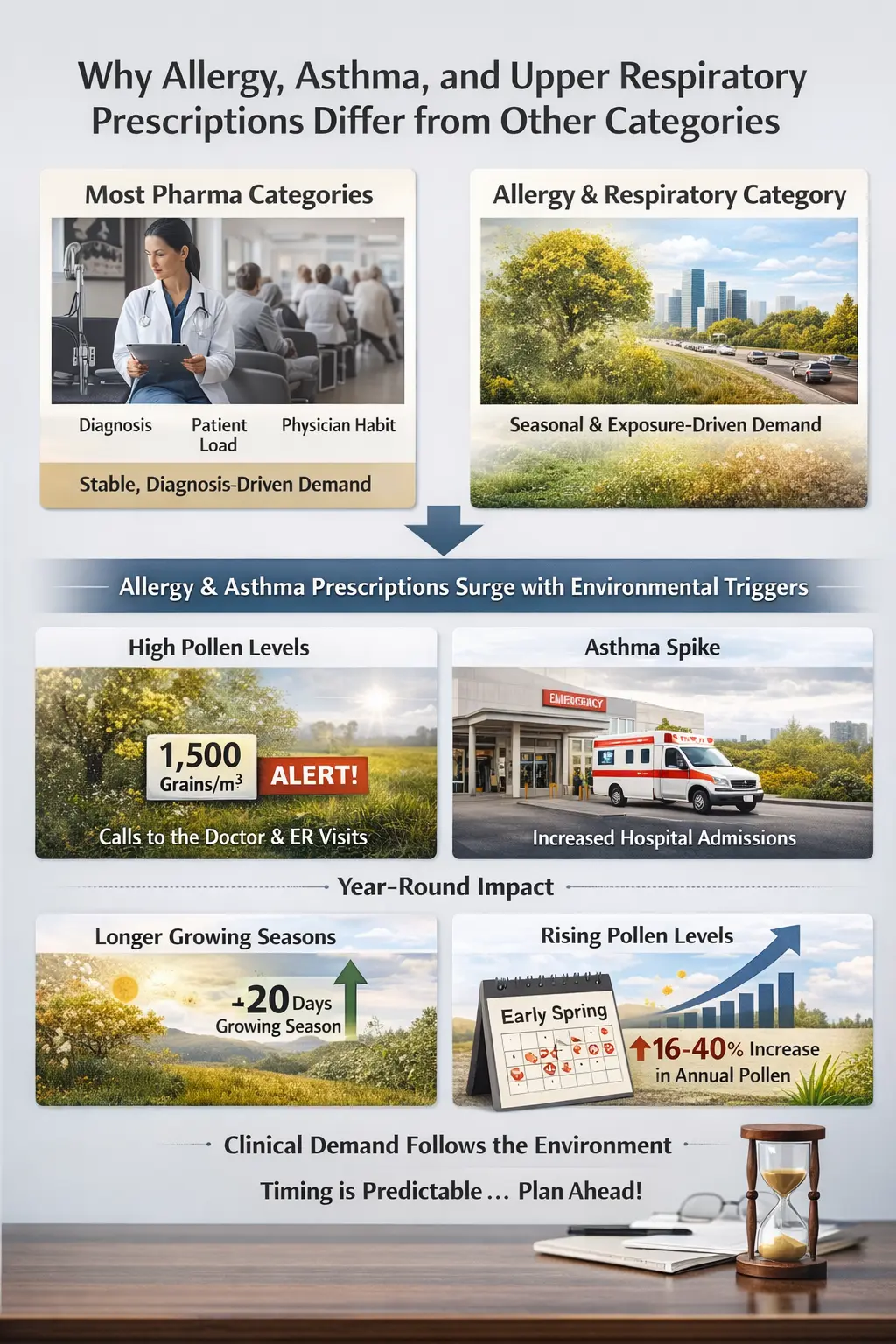
Allergy and respiratory diseases are different. Demand in this category is, by definition, exposure-driven.
A patient with allergic rhinitis doesn't visit their doctor on a schedule. They call when tree pollen hits 1,500 grains/m³ and they can't get through a workday. A patient with allergic asthma does not experience exacerbations on a calendar. A study tracking asthma hospital admissions in London found a clear association between grass pollen concentrations and unplanned asthma admissions, with a 4–5 day lag after high-pollen days meaning clinical demand arrives not when allergens peak but slightly after (PMC, 2017). Another systematic review of over 28 studies found consistent associations between high pollen counts and emergency department presentations for asthma exacerbations across children and adults (PMC, 2025).
This is also true across the full upper respiratory prescribing stack – antihistamines, intranasal corticosteroids (INCs), ICS/LABA combinations, and leukotriene receptor antagonists. These aren't niche products. The Journal of Allergy and Clinical Immunology's 2020 Rhinitis Practice Parameter explicitly recognizes that medication timing "concurrent with or in anticipation of defined seasonal exposure" is a clinical best practice for seasonal allergic rhinitis (JACI, 2020).
But here's what's striking: if anticipatory prescribing is already the clinical best practice, why aren't pharma commercial teams using anticipatory field execution to match it?
The allergy and asthma prescribing pattern is also increasingly year-round, not just seasonal. A 2023 review in the World Allergy Organization Journal noted that in many climatic regions, the same allergen can be either seasonal or perennial depending on local conditions and that AR patients "often need continuous treatment," extending the commercial opportunity well beyond the classic spring peak (WAOJ, 2023). Climate change is accelerating this. The freeze-free growing season across the U.S. has already lengthened by an average of 20 days since 1970, and researchers at the University of Michigan project spring pollen seasons could begin 40 days earlier than historical norms by end of century, with annual pollen totals rising 16–40% (Nature Communications, 2022).
In short: this is a category where the timing of clinical demand is increasingly predictabl and increasingly misaligned with how most commercial teams plan.
Before getting to the operational piece, it's worth being concrete about the evidence connecting pollen exposure to prescribing behavior, because the issue isn't theoretical anymore.
Across markets and data sources, the pattern is consistent: pollen drives demand, and the signal appears before prescriptions are written.
“Signal Timeline” → Pollen ↑ → Search ↑ → OTC ↑ → Visits ↑ → Rx ↑
The signal is there. It's consistent across geographies, product classes, and data types. The prescribing demand in allergy and respiratory Rx is not random. It is driven by exposure, and that exposure is now measurable and forecastable at regional resolution.
Here's what happens in most commercial teams when better environmental data becomes available.
Someone in analytics builds a dashboard. The brand lead reviews it and finds it genuinely useful. There's a conversation about how to integrate it into planning. That conversation runs into the reality that:
The new data gets bookmarked. The next cycle starts. Nothing changes.
This is not a people problem. It's a structural one. Pharma field operations were designed for predictable, stable categories. They weren't designed to flex on a four-week pollen window.
The operational research on Allergy Rx tech teams confirms this exactly, calling out legacy CRM systems without climate data APIs, siloed analytics environments, and the fact that traditional forecasting misses significant demand opportunities in high-pollen periods when it relies on historical sales data alone. The organizational cost is real: field teams resist change not because they disagree with the logic, but because adoption competes with existing workflow without clear integration support.
The solution isn't to rebuild the workflow. It's to insert one upstream decision into the existing one.
The single most important reframe for commercial teams considering climate-aligned execution is this: you are not replacing your commercial model. You are giving it better timing.
Your prescriber list stays. Your territory structure stays. Your segmentation logic stays. Your CRM stays. Your call plan structure stays.
What changes is the weighting of effort within that structure over a defined period typically four to six weeks based on where environmental exposure is creating or about to create clinical demand.
Here's what shifts in practice:
Instead of "Who prescribed the most last year?"
You add: Who is practicing in a geography entering a peak demand window right now
Instead of "Fixed call frequency across all territories equally
You add: Elevated call intensity to high-PEI (Pollen Exposure Index) regions for the duration of the window
Instead of: Campaign launch tied to Q2 budget cycle
You add the following: Campaign activation triggered by regional pollen threshold crossing
Instead of: HCP engagement scheduled at rep convenience
You add: HCP engagement timed to when physicians are actively seeing patients in exacerbation - the moment your message is most clinically relevant
That last point matters more than it sounds. MMIT research found that over 50% of physicians now meet with only three or fewer pharma companies on a regular basis (MMIT, 2024). Access is limited. The question isn't just whether you get in the room. It's whether you show up when the physician's mind is on the clinical problem your product solves. A rep walking into an allergist's practice during a high-pollen week, with a message calibrated to the regional exposure conditions their patients are dealing with, lands differently than the same rep arriving in a low-demand window with a generic unbranded call.
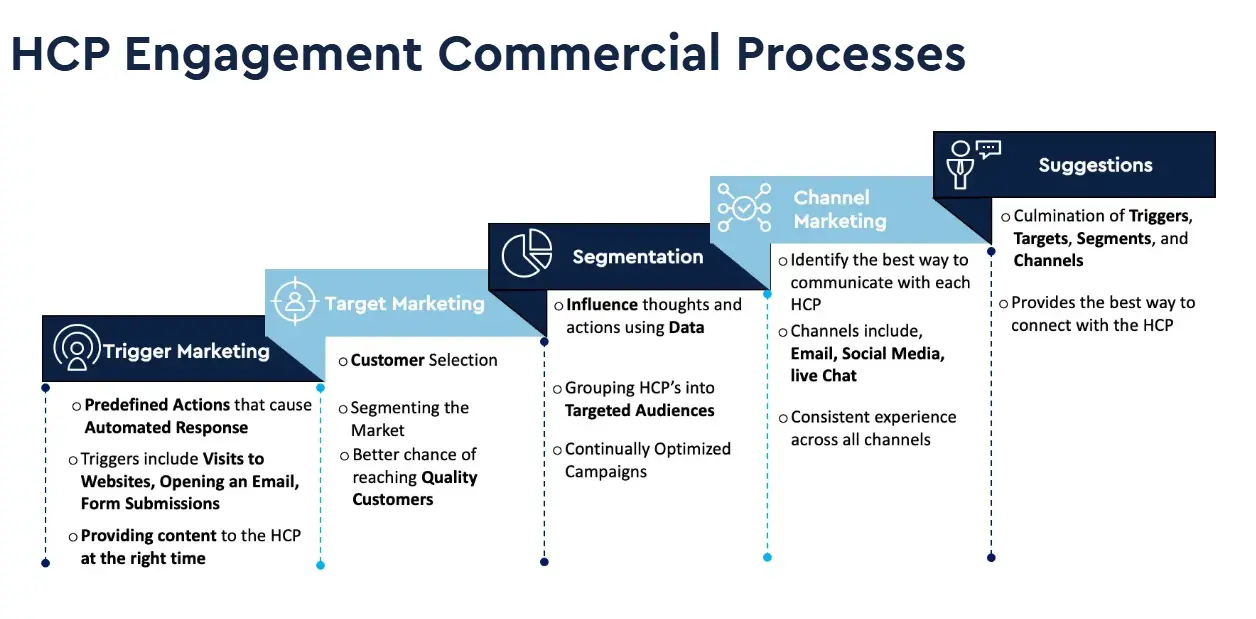
Tenthpin's analysis of advanced HCP engagement models captures this well: the principle is that "the HCP will receive a message with the correct content when convenient for them to receive it, not when convenient for our pharma sales rep to send it" and that using contextually appropriate timing is what drives receptivity.
Climate data gives you the context. The peak window gives you the timing. The rest is your existing commercial infrastructure.
Teams that move quickly on these initiatives don't try to deploy climate intelligence across their entire commercial operation at once. They start with one question:
Where should field effort increase in the next four weeks?
The workflow, using ClimaChain, is:
This approach adds one upstream input to a decision your field operations team is already making. No new CRM. No retraining. No restructured territories. No new compliance process.
One thing worth naming directly: doing nothing here is not a neutral position.
When field calls land outside demand windows, the call still happens, the rep still drives, the promotional material still gets printed but the physician isn't thinking about allergy or respiratory exacerbations. There's no potential of patients coming in front of them right now with a problem your drug solves. The message lands in an empty room.
When campaigns run in the six weeks before or after a regional pollen spike, the spend goes out on schedule, but it's working against a backdrop of low clinical urgency. The ROI looks soft. Leadership asks why.
When high-pollen-growth geographies get missed because territory prioritization didn't account for exposure trends, a competitor's rep is in those offices instead not because they were smarter, just better timed.
These losses don't show up as a single line item. They show up as
"regional inconsistency,"
"unpredictable seasonal performance," and
"lower-than-expected campaign ROI."
The root cause is simpler: timing and geography were misaligned with where demand actually was.
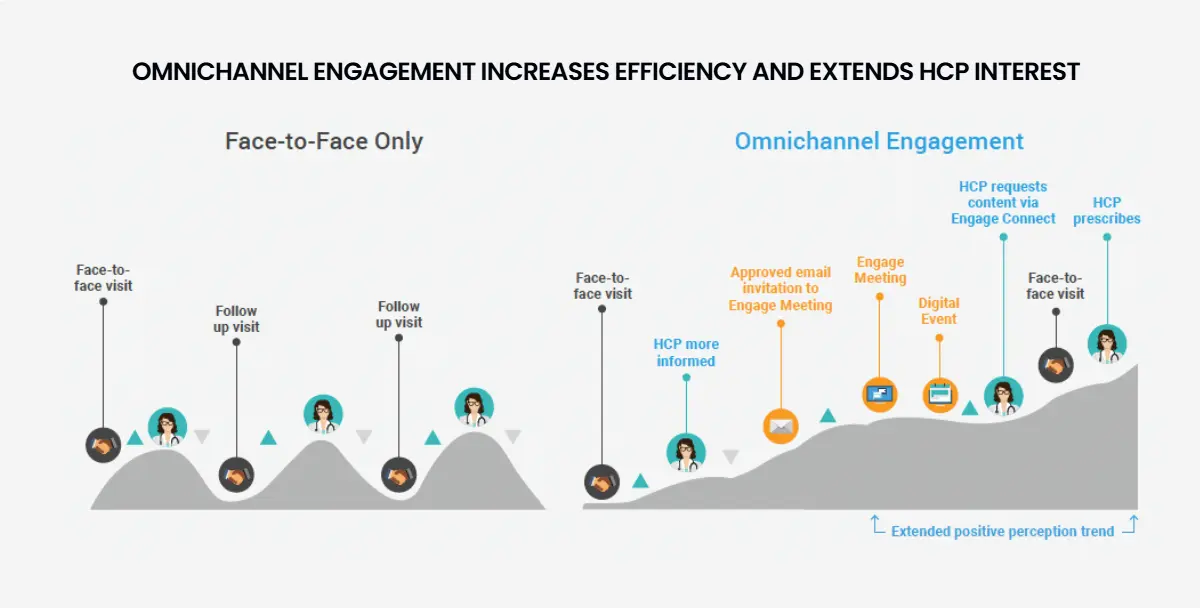
Veeva analysis of pharmaceutical sales team planning cited estimated revenue losses in the range of $45–90 million from execution lag and misaligned field timing in comparable scenarios.
The conventional forecast model built on historical sales data without environmental layers misses significant demand opportunities in high-pollen periods, compounding over each season without the team realizing the pattern.
The operational research on Allergy Rx tech adoption identifies real barriers: legacy CRM systems without climate data APIs, siloed data environments, and field team resistance to new tools. These are legitimate.
But the integration path for ClimaChain's approach doesn't require solving all of them at once.
The minimum viable integration is a climate intelligence layer: PEI scores and Peak Demand Windows delivered as a weekly briefing, overlaid manually against your existing territory maps and prescriber prioritization. No CRM change. No IT project.
The teams that capture the most value are the ones that start with the manual layer, prove the commercial logic in one region over one season, and then use that proof to justify the deeper integration.
Pollen seasons are already longer and more intense than they were a decade ago. They are going to keep shifting. The geographic distribution of peak allergy windows will continue to diverge from historical patterns. And the prescribing response to those windows follows the exposure signal with enough predictability to plan against.
The teams that build climate responsiveness into their commercial execution now are not doing something exotic. They are doing what good commercial planning has always required: aligning effort with demand.
The difference is that demand in allergy and respiratory drugs is now forecastable at a level of geographic precision that didn't exist a decade ago.
ClimaChain gives you the ability to move from observing seasonal demand to acting on it before it peaks in prescription data layering on top of what your field force and CRM already do, without replacing any of it.
The signal is there. The question is whether your commercial structure is positioned to respond to it.
Ready to see how climate-aligned HCP targeting applies to your territories and call plans?
Explore ClimaChain. [Map your territories against the next demand window →]
00:00
/
00:00
00:00
/
00:00
00:00
/
00:00
00:00
/
00:00








.webp)