Resources /
Blogs
How to improve demand forecasting accuracy: 9 proven strategies
January 14, 2026
DVS Roopesh
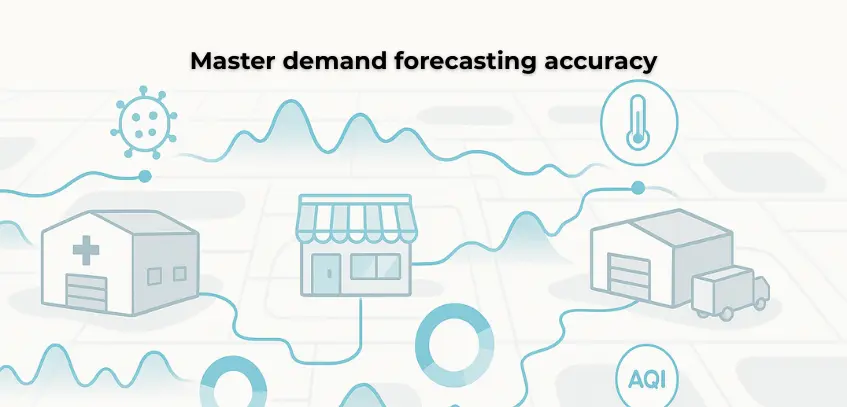
To improve demand forecasting accuracy, combine historical data analysis, collaborative planning, machine learning models, and environmental data. Use real-time demand sensing, monitor forecast errors, and align sales forecasting methods for better outcomes.
{{key-insights}}
In today's volatile market landscape, accurate demand forecasting isn't just a competitive advantage; it's a business necessity. Companies with superior forecasting capabilities consistently outperform their competitors by maintaining optimal inventory levels, reducing costs, and delivering exceptional customer experiences.
According to McKinsey, companies with high forecast accuracy reduce inventory errors by up to 50% and improve fill rates by 10-20%.
This article outlines nine proven strategies to improve demand forecasting accuracy, including collaborative forecasting, leveraging historical data, incorporating environmental factors, and applying advanced analytical methods.
Demand forecasting accuracy measures how closely forecasted demand aligns with actual demand. High accuracy ensures optimal inventory levels, reduces holding costs, and enhances customer satisfaction. Conversely, poor accuracy can lead to overproduction or underproduction, which have financial and environmental consequences.
For instance, accurate demand forecasts can reduce overproduction and underproduction, leading to less waste and lower energy consumption.
Understanding and monitoring these metrics help identify areas for improvement in forecasting models.
Common errors in demand forecasting include human biases, incorrect assumptions, and reliance on outdated data. These errors can lead to lost sales, inflated safety stock, and increased holding costs. For example, underestimating demand may result in stockouts, while overestimating leads to excess inventory and potential markdowns.
Forecasting accuracy can vary across product categories due to differences in product lifecycle stages and market volatility. For instance, fast-moving consumer goods may have more predictable demand patterns compared to seasonal products. Setting category-specific accuracy benchmarks allows for more tailored and effective forecasting strategies.
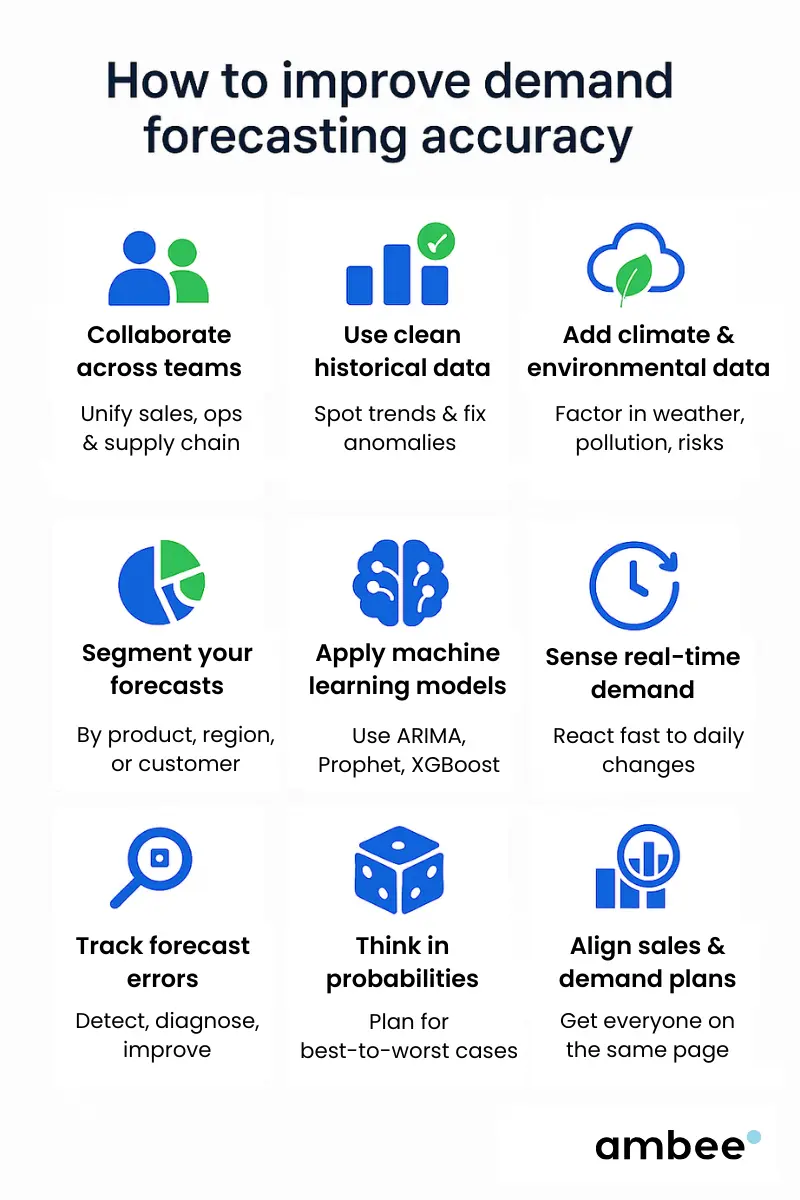
Involving sales, marketing, operations, and supply chain teams in the forecasting process ensures that diverse insights and data points are considered, leading to more accurate forecasts. Breaking down data silos and fostering communication among departments can align objectives and improve forecast reliability.
One proven approach is Collaborative Planning, Forecasting, and Replenishment (CPFR), which enhances visibility and synchronization across the supply chain, leading to better forecasting outcomes and reduced inventory discrepancies.
Collaborative forecasting leverages shared metrics and aligned incentives, ensuring that all departments work towards common goals. This approach reduces discrepancies between forecasts and actual demand by incorporating various perspectives and data sources.
Analyzing historical sales data helps identify trends, seasonality, and demand patterns. Cleaning and normalizing this data, detecting outliers, and tagging special events enhance the quality of forecasts.
Utilizing data cleansing tools and statistical methods to identify and correct anomalies ensures that historical data accurately reflects demand patterns. Comparing forecasts before and after data cleaning can illustrate the impact of data integrity on forecast accuracy.
Environmental factors such as weather, AQI, and illness (ILI) windows significantly influence demand, yet many companies still lean on last year’s curve because it feels familiar. However, climate doesn't repeat on a schedule. Integrating high-resolution environmental data moves beyond stagnant historical patterns to expose hidden demand. This transition from "safe" forecasting to climate-aware modeling is where incremental revenue and improved supply decisions quietly sit.
ClimaChain by Ambee offers robust APIs and comprehensive documentation, facilitating seamless integration of environmental data into existing systems.
For further insights, explore:
Segmenting forecasts by product, region, or customer behavior allows for more precise demand predictions.
While general forecasting establishes a baseline, segmentation becomes critical in the following scenarios:
Hyper-local data helps isolate these patterns down to specific geographic areas, enabling targeted inventory and marketing strategies.
Advanced models like ARIMA, Prophet, and XGBoost can capture complex demand patterns and improve forecast accuracy. These models analyze time series data to identify trends and make predictions.
Many of these methods are extensively studied in the International Journal of Forecasting, which explores cutting-edge techniques in quantitative forecasting.
The effectiveness of forecasting methods varies by use case. Visual comparisons of model performance across different scenarios can help determine the most suitable approach for specific products or markets.
Demand sensing involves using real-time data, such as point-of-sale information, web traffic, and weather feeds, to adjust forecasts on a daily or hourly basis. This approach enables businesses to respond quickly to demand fluctuations.
Regularly monitoring, reviewing, and analyzing forecast errors helps identify root causes of inaccuracies. Implementing a structured workflow for error analysis enables continuous improvement of forecasting models.
Establishing this workflow promotes continuous improvement and enhances forecast reliability.
Traditional point forecasts provide a single estimate of future demand, which may not capture the inherent uncertainty in the market. Probabilistic forecasting, on the other hand, generates a range of possible outcomes with associated probabilities, offering a more comprehensive view of potential future scenarios.
By incorporating confidence intervals and scenario modeling, businesses can better assess risks and make informed decisions under uncertainty. For example, probabilistic models can quantify demand volatility, enabling more effective inventory management and service level optimization.
Aligning sales forecasts with demand planning ensures that both sales and operations teams work towards common objectives using consistent data. This integration facilitates better resource allocation, production scheduling, and inventory management.
Collaborative planning processes, such as Sales and Operations Planning (S&OP), help synchronize cross-functional activities, leading to improved forecast accuracy and organizational efficiency.
This approach is especially critical when exploring how to improve forecasting accuracy using sales forecasting methods. By aligning top-down and bottom-up perspectives, companies reduce misalignment between expectations and execution, ultimately delivering more accurate forecasts.
Integrating environmental data into demand forecasting models can significantly enhance accuracy by accounting for external factors that influence consumer behavior. Weather conditions, for instance, have a profound impact on purchasing patterns across various industries.
Weather variations trigger predictable shifts in consumer preferences and purchasing urgency:
A Harvard Business Review study found that retailers incorporating weather data into their forecasting saw up to 20% improvement in prediction accuracy.
By incorporating these environmental signals into your forecasting models, you can anticipate demand shifts days or even weeks before they materialize in sales data.
While virtually all businesses can benefit from environmentally-enhanced forecasting, these sectors see the most dramatic improvements in accuracy:
Advancements in Artificial Intelligence (AI) have revolutionized demand forecasting by enabling the analysis of complex datasets, including environmental variables.
The effectiveness of your forecasting improvement efforts depends heavily on data quality. According to Gartner, organizations should evaluate data sources based on:
ClimaChain is Ambee’s climate-powered demand planning and forecasting platform, offering robust APIs and detailed documentation for easy integration into your existing forecasting systems.
Even with advanced data integration, businesses must navigate several forecasting complexities:
Predicting demand is difficult when there is no historical truth to lean on. Early signals are often distorted by channel fill, promotional lift, and regional noise. Without external signals like seasonality or environmental exposure, early forecasts miss both massive upside and significant risk.
Nielsen's research on new product forecasting recommends:
Weather anomalies can dramatically disrupt standard forecasting models. The World Economic Forum's Global Risks Report emphasizes the growing importance of climate resilience in business planning.
To build forecasting resilience:
When unusual weather patterns emerge, businesses with environmental data integration can rapidly recalibrate forecasts.
According to research from Supply Chain Management Review:
By integrating ClimaChain’s real-time climate intelligence, businesses gain early warning signals of weather-driven demand shifts, enabling faster forecast adjustments and improved operational preparedness.
To enhance resilience against climate variability, businesses should focus on:
Develop a robust data governance framework to ensure the accuracy and reliability of environmental data used in forecasting. This includes:
Develop models that:
This adaptability helps organizations maintain forecast accuracy even in rapidly changing environmental conditions.
Quantify the business value of your forecasting improvements by measuring:
Inaccurate forecasts can lead to substantial financial losses due to overstocking, stockouts, and inefficient resource utilization.
By improving forecast accuracy through advanced data integration, businesses can reduce these costs and enhance profitability.
ClimaChain by Ambee can deliver measurable ROI from the very first forecasting cycle by aligning inventory decisions with climate-informed demand signals, minimizing waste and boosting sales.
Enhancing demand forecasting accuracy requires a multifaceted approach that combines collaborative planning, historical data analysis, advanced analytical methods, and the integration of environmental data.
By implementing the strategies mentioned above, businesses can build resilient forecasting systems that adapt to market dynamics and environmental variability; ultimately driving better decision-making and improved financial performance.
This roadmap not only shows you how to improve demand forecasting accuracy, but also guides you on how to improve forecasting accuracy using sales forecasting methods, environmental intelligence, and AI; all critical for modern supply chain success.
00:00
/
00:00
00:00
/
00:00
00:00
/
00:00
00:00
/
00:00